
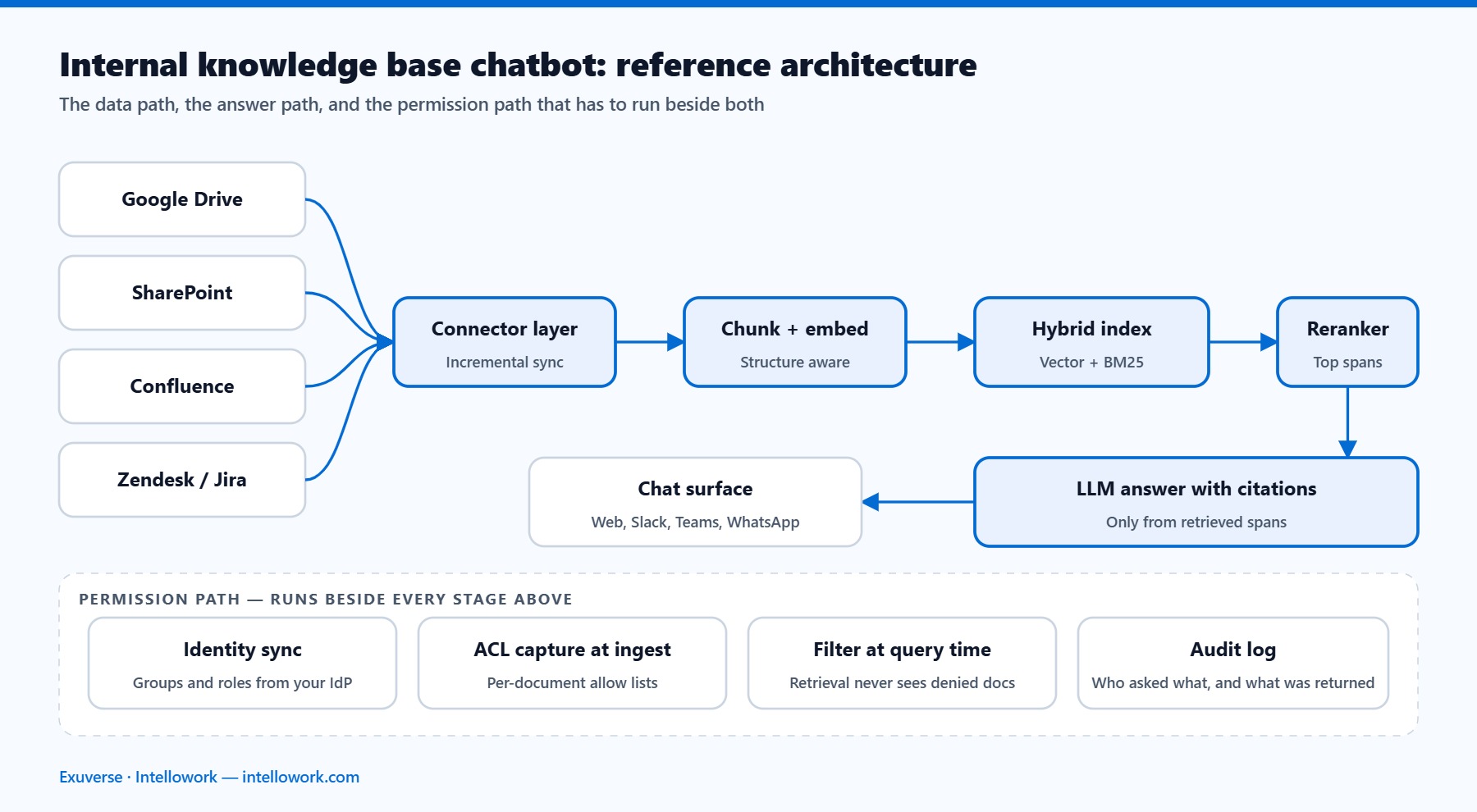
Internal Knowledge Base Chatbot: The Architecture That Survives Production
Building an internal knowledge base chatbot is a weekend project. Building one your company still trusts six months later is an architecture problem.
We build these systems for clients — and productised the pattern in IntelloWork — so here is the architecture that survives, layer by layer.
Layer 1: Ingestion That Respects Reality
Your knowledge is not one clean corpus. It is a Solr index someone built in 2021, a wiki, three drives, and an HR system with an API. The ingestion layer must connect to all of it in place — chunking, embedding, and re-indexing on change — without a migration project. The engineering details are in our guides on building RAG systems and RAG for internal knowledge bases.
Layer 2: ACLs Inside the Index
The production-killer. Permissions checked at the app layer eventually leak — a reranker surfaces a chunk the filter missed, and a confidential document answers an intern’s question. Access controls must be fields in the index, applied as filters at query time, every query. We covered the failure modes in secure RAG for private data.
Layer 3: Hybrid Retrieval With a Confidence Floor
Vector search for meaning, lexical for exact terms (ticket numbers, product codes, names), a reranker on top — and a confidence threshold below which the bot says “I am not sure” instead of improvising. The threshold is not a nicety; it is the difference between a tool and a liability. Tuning it is half art: see AI-driven relevance tuning.
Layer 4: Citations as a Hard Requirement
Every answer names its source document and section. This is not UX polish — it is the audit trail that lets a wrong answer be traced to a stale document instead of eroding trust in the whole system.
Layer 5: Delivery Decoupled From Retrieval
The same pipeline should serve a web widget, Slack, Teams, and WhatsApp — because adoption lives where people already work. Couple the channel to the pipeline and you will rebuild everything for channel two.
Build It or Buy the Pattern
Everything above is buildable — our guides show how, and we build it for clients with unusual requirements. But if your requirement is the standard one — cited answers over existing content, permissions intact, on every channel — the pattern is already productised: IntelloWork ships these five layers as a workspace, and its internal knowledge base chatbot guide covers the buyer’s view of this same architecture.
The honest decision framework is in our build vs buy guide — written by a team that profits either way you choose.
Chunking decisions that determine everything downstream
Chunking looks like a tuning parameter and behaves like an architectural commitment. Get it wrong and no amount of reranking, prompt engineering or model upgrading recovers the quality, because the information the answer needs was never in a single retrievable unit.
- Split on structure, not on character count. A policy document splits at clause boundaries, an API reference at endpoint boundaries, a runbook at step boundaries. Fixed-size windows cut sentences in half and produce chunks that are individually meaningless.
- Carry the heading path into every chunk. A paragraph that says “this must be approved by the regional manager” is useless without knowing which section it sits in. Prepending the document title and heading trail costs a few tokens and materially improves both retrieval and citation quality.
- Keep tables intact. A table split across chunks produces answers that confidently read values from the wrong row. If a table exceeds the chunk budget, serialise it into labelled rows rather than truncating it.
- Give every chunk a stable identity. Document identifier, version, section anchor and source URL. This is what makes a citation openable, what makes deletion possible when an erasure request arrives, and what lets you re-index one document without rebuilding the corpus.
Permission propagation, which is where most designs quietly fail
The index is a second copy of your content with its own access model, and that model is usually weaker than the one in the source system. Three design decisions keep them aligned.
Store entitlements alongside the chunk, and filter inside the query. Every chunk carries the identifiers of the groups or roles permitted to see it, and retrieval filters on the requesting user’s resolved entitlements before scoring, not after. Filtering results after generation is not access control; it is a leak with an extra step.
Define and measure your permission lag. When someone changes team or a document is reclassified, how long until the index reflects it? Whatever the answer, it should be a number you know and monitor rather than a property you hope about. Event-driven updates from the source system are far better than nightly re-crawls, and a nightly re-crawl means a full working day of stale entitlements.
Handle deletion as a first-class path. A document removed at source must disappear from the index and from any cached answer within a defined window. Stable chunk identity is what makes this a delete operation rather than a full rebuild. Our guide to secure RAG on private data covers the index-level implementation, and role-based access in AI chatbots covers how to test it.
Failure modes worth designing against
- The confidently outdated answer. Two versions of a policy in the corpus, the older one better written and therefore better matched. Fix with recency signals in reranking and by actually retiring superseded documents rather than leaving them in a folder.
- The exact-identifier miss. A user searches an error code or part number and dense retrieval returns semantically similar but wrong content. This is why hybrid keyword and vector retrieval is not optional — see hybrid keyword and vector search.
- The multi-document question. Answers that require combining two sources fail silently when retrieval depth is tuned for precision. Retrieve broadly, then rerank hard, rather than retrieving narrowly.
- The poisoned document. Instructions embedded in indexed content that change the assistant’s behaviour. Keep retrieved text structurally separate from instructions and never let it authorise an action. Our note on prompt injection prevention goes deeper.
What to measure before you call it production
Four numbers, on a fixed question set, tracked across releases rather than measured once: answer accuracy, groundedness, correct-refusal rate, and permission leakage as a binary. Instrument the retrieval decisions so a bad answer can be traced to the chunk that caused it, as described in LLM observability for internal AI assistants. If you are choosing a platform rather than building this yourself, the same properties form the backbone of our evaluation checklist and our platform comparison.
Frequently asked questions
What chunk size works best for an internal knowledge base?
Structure matters more than size. Split at natural boundaries — clause, section, endpoint, procedure step — and let the resulting chunks vary in length, with an upper bound rather than a target. Prepend the document title and heading path to every chunk so each one is independently meaningful.
Do we need a dedicated vector database?
Not necessarily. For corpora up to a few million chunks, pgvector alongside your existing PostgreSQL, or a search engine that supports both keyword and vector scoring, is simpler to operate and easier to keep in sync with permissions. A dedicated vector store earns its place at larger scale or when you need capabilities your primary store lacks.
How often should the index be refreshed?
Content changes can tolerate a scheduled crawl. Permission changes cannot. Aim for event-driven updates on entitlements and deletions, and treat any lag as a measured, monitored property rather than an assumption.
Should the assistant answer when retrieval returns nothing good?
No. A confidence floor that produces an honest “I could not find this in the knowledge base”, ideally with the closest related documents, protects trust far more effectively than an extra few percentage points of coverage. Users forgive a system that says it does not know; they abandon one that invents.
Written by Tarun Gupta, founder and AI architect at Exuverse and the architect behind Intellowork. Last reviewed 31 August 2026.
Read next: For a worked example of this architecture in HR, see our guide to the HR policy chatbot.
Read next: AI onboarding assistant: getting new hires productive in week one