Build vs Buy: Enterprise AI Chatbot — An Honest Answer From a Team That Does Both
We are in an unusual position to answer this question.
Exuverse builds custom RAG and chatbot systems for clients — and we also build IntelloWork, a product that ships the same architecture off the shelf. We profit either way you decide. So here is the honest decision framework.
What “Build” Actually Involves
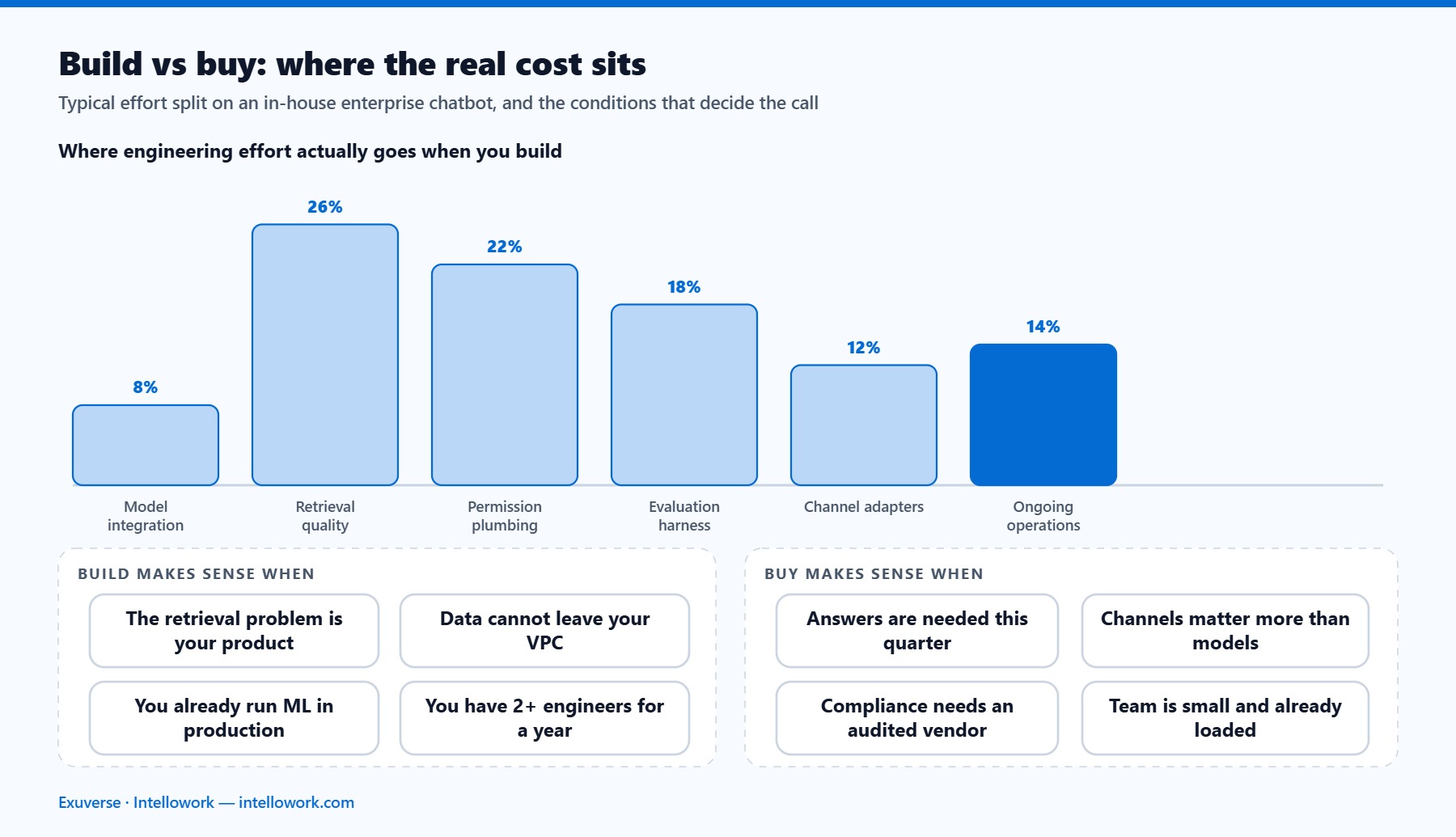
A production enterprise chatbot is not a weekend LLM wrapper. Our own build guides show the real scope:
- RAG pipeline design — chunking, embeddings, retrieval policy
- Hybrid keyword + vector search with reranking and confidence thresholds
- Security and ACL enforcement inside retrieval — the part most builds discover late
- Citations, evaluation, and hallucination control
- Channel engineering — web widget, WhatsApp Business API, Slack, Teams — each with its own auth, formatting, and rate limits
- Operations: reindexing, monitoring, model upgrades, forever
Realistically that is a multi-engineer effort measured in months to reach production quality — and a permanent ownership cost after launch. Our chatbot development cost guide puts numbers on it.
When Building Is Right
- The chatbot is your product, or a core differentiator you must control completely
- You have retrieval requirements no platform supports — exotic sources, unusual ranking, regulatory constraints on architecture
- You already run search/ML engineering as a permanent capability
When Buying Is Right
- The goal is answers for employees or customers from content you already have
- You need multiple channels — web, WhatsApp, Slack, Teams — without four engineering projects
- You want the trust layer (citations, ACLs, confidence handling) proven, not invented in-house
- Time-to-value matters more than architectural ownership
That profile — most companies, honestly — is what IntelloWork exists for: it connects your Solr indexes, websites, files, and APIs, and ships cited answers to every channel from one pipeline. The integration guide shows the path.
The Third Option Nobody Mentions: Buy the Platform, Build the Edges
The best outcomes we see are hybrid: a platform for the proven 90% — retrieval, citations, channels, permissions — and targeted engineering for the 10% that is genuinely yours: custom connectors, transactional flows into your systems, domain-specific evaluation.
That is also how we work: IntelloWork as the foundation, Exuverse engineering for the edges. If you are weighing the decision for your organisation, talk to us — we will tell you honestly which side of the line you are on.
Deeper dives: the internal knowledge base chatbot architecture that survives production · what it takes to build an AI employee.
If you land on buy: the engineering due-diligence checklist for chatbot platforms.
The cost model, with the invisible lines filled in
Build-versus-buy arguments usually compare a licence quote against an engineering estimate for the first release. That comparison is wrong in both directions. The licence quote understates the internal work a bought platform still requires, and the engineering estimate understates everything after launch.
A more honest model has four columns, and both options have entries in all four.
| Cost line | Build | Buy |
|---|---|---|
| First working version | 4 to 8 engineering weeks | Days to a first answer |
| Content remediation and permission clean-up | Unavoidable | Unavoidable, identical scope |
| Evaluation set, built and maintained | Yours to build and run | Yours to build, vendor may host |
| Ongoing operations | Vector store, connectors, model upgrades, on-call | Vendor operated, integration surface still yours |
| Cost trajectory | Infrastructure plus a permanent share of engineering headcount | Licence, usually scaling with seats or usage |
Note that the second and third rows are identical in both columns. Content remediation and evaluation are not features you can buy; they are work your organisation does regardless. Any business case that assigns them only to the build column is comparing the wrong things. The detailed breakdown is in our note on AI chatbot development cost.
The failure modes of each path
Both paths fail in characteristic ways, and knowing the shape in advance is most of the defence.
Build fails through attrition. The two engineers who understood the chunking strategy move to another team. Connectors quietly break when a source system changes its API. The evaluation set stops being run because nobody owns it. Eighteen months later the assistant is a system nobody wants to touch and nobody quite trusts, and the rebuild costs more than the original build.
Buy fails through mismatch. The platform’s assumptions about your content turn out to be wrong in one important way — a permission model it cannot express, a document format it chunks badly, a channel it does not support — and the workaround becomes a permanent tax. Because you cannot change the retrieval layer, the ceiling on answer quality is set by someone else’s roadmap.
The mitigation for the first is naming an owner and a maintenance budget on day one. The mitigation for the second is testing the specific mismatch risks during evaluation rather than after signature, which is what our evaluation checklist is designed to force.
A decision rule you can apply in one meeting
- Is retrieval quality something you sell, or something you use? If you sell it, build. If you use it, buying is almost always cheaper over three years.
- Do you have a permanent team that will still own this in two years? Not a project team. A permanent one. If not, do not build.
- Is there a hard constraint no vendor meets? True data sovereignty requirements, an unusual permission model, an air-gapped environment. If yes, you may have no choice.
- How many channels do you need? Every additional channel — Slack, Teams, WhatsApp, voice, web — is weeks of build work and a line item in a platform. Channel count is where build estimates go wrong most often.
If the answers point to buying, the next question is which platform, and the options differ more than the marketing suggests. Our comparison of enterprise AI chatbot platforms works through Glean, Microsoft 365 Copilot, Onyx and Intellowork on the axes that actually decide it.
Frequently asked questions
Is it cheaper to build or buy an enterprise AI chatbot?
Building is usually cheaper for the first three months and more expensive over three years, because the ongoing cost is a permanent share of engineering capacity rather than a one-off project. Buying is cheaper unless retrieval quality is a product differentiator for you or a hard constraint rules every vendor out.
How long does it take to build an enterprise AI chatbot in-house?
A working prototype on a clean corpus takes a competent team two to four weeks. A production system with permission enforcement, citations, evaluation and observability takes three to six months, and then requires continuous ownership rather than occasional maintenance.
Can we start by buying and move to building later?
Yes, and it is often the sensible sequence, provided you keep the two assets that transfer: your evaluation set and your cleaned, well-permissioned corpus. Both are platform-independent and both represent most of the real work. Ask during procurement whether you can export them.
What about open-source platforms — is that building or buying?
Operationally it is building, with a head start. You skip the initial development but inherit the full running cost: infrastructure, upgrades, connector maintenance and on-call. Choose it for the control and the licence economics, not because it looks like a free version of buying.
Written by Tarun Gupta, founder and AI architect at Exuverse and the architect behind Intellowork. Last reviewed 31 August 2026.