
AI chatbot citations are the difference between an answer a reader believes and an answer a reader can check. That distinction sounds academic until the first time your docs assistant confidently describes a configuration flag that has never existed, and a customer builds a release around it.
Most teams treat citations as a UI garnish: append two links to the bottom of the response and move on. Done that way, they are decorative at best and actively misleading at worst. Done properly, citations are an architectural constraint that runs from chunking through retrieval to generation, and they are the single most effective control against hallucination in a documentation assistant.
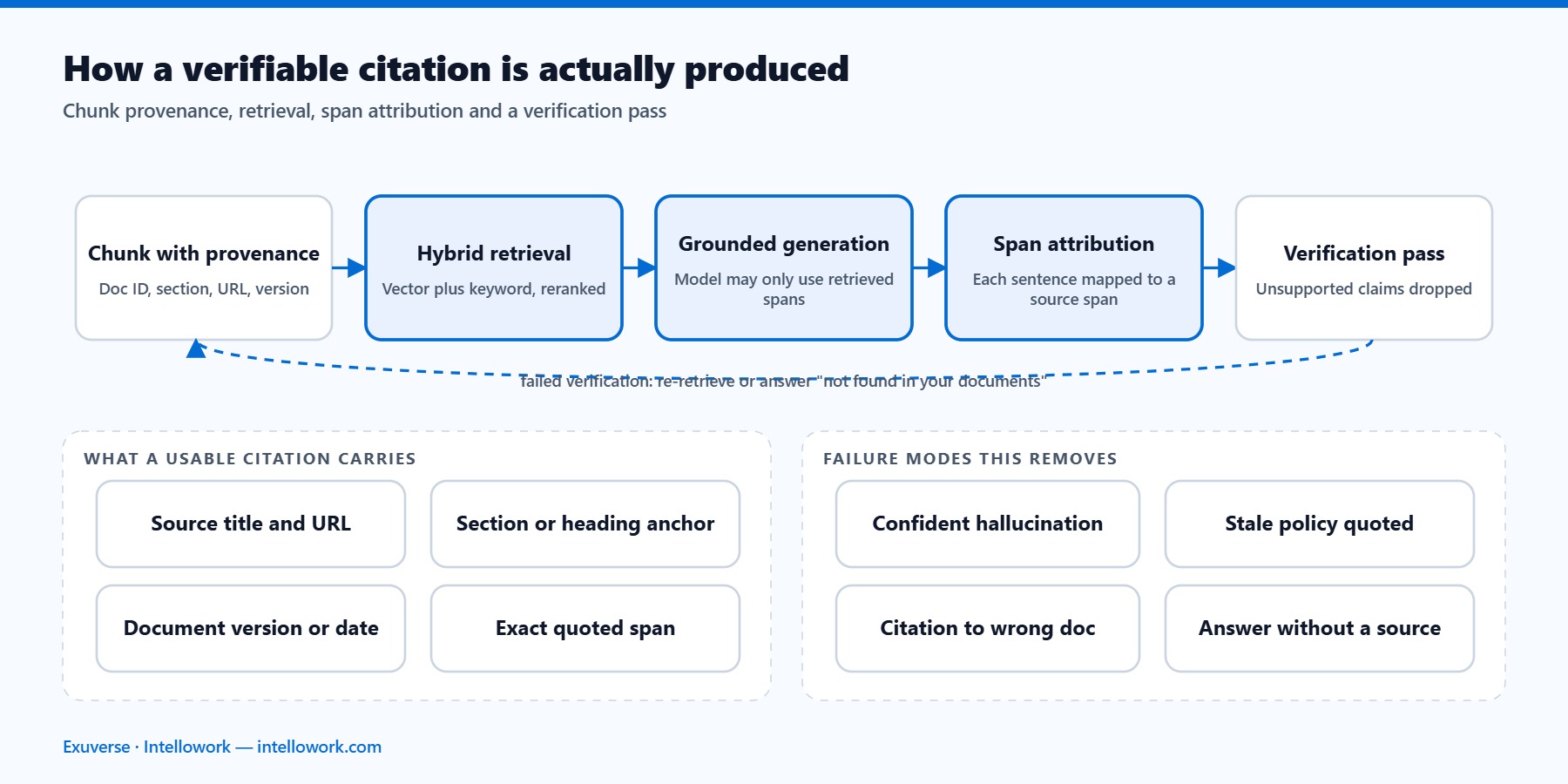
Why citations matter more than model choice
Every frontier model will occasionally produce fluent, well-structured, entirely wrong text. You cannot buy your way out of this by upgrading models, because the failure is not a capability gap. It is what happens when a model is asked a question the provided context does not answer, and nothing in the system tells it that declining is allowed.
Citations attack the problem from three directions at once:
- They constrain generation. A model required to attribute each claim to a retrieved passage has far less room to improvise.
- They make errors detectable. An uncited claim is a flag your evaluation harness can catch automatically, before a customer does.
- They transfer verification to the reader. A developer who can open the exact heading in one click will trust the system faster than any confidence badge could achieve.
That last point is underrated. Trust in a docs assistant is not built by being right; it is built by being checkable. Readers forgive a refusal. They do not forgive a confident invention that cost them an afternoon.
What counts as a real citation, and four that do not
A real citation identifies the specific passage that supports a specific claim, links to a stable location where the reader can see that passage in context, and reflects the version and freshness of the content used. Anything less is theatre.
| Pattern | What it looks like | Why it fails |
|---|---|---|
| The page dump | Three page-level links under the answer | Reader must re-find the relevant paragraph in a 4,000-word page |
| The model-authored link | A URL the model wrote itself | Frequently invented; must come from retrieval metadata, never from generation |
| The retrieval receipt | Links to everything retrieved, used or not | Implies support the passages never provided |
| The undated citation | A correct link to a page last updated in 2023 | Accurate attribution to obsolete guidance |
The second row is worth stating twice. Citation URLs must be assembled from the metadata of the passages that were actually retrieved. The moment a link is produced as part of the generated text, it can be fabricated, and fabricated links are worse than none because they look like evidence.
Citation-grade retrieval starts at chunking
You cannot cite what you cannot address. If a chunk is an arbitrary 800-character window, the best citation you can offer is the page it came from. Precision has to be built in earlier.
Give every chunk an identity
Each chunk should carry a stable passage ID, the canonical URL with a heading anchor, the full heading trail, the document version, the language, and the last-updated timestamp. That payload travels with the chunk through retrieval and into the citation the reader sees.
Split on meaning, not on length
Chunk boundaries should follow headings, list groups, and code blocks. A chunk that begins mid-sentence produces a citation that reads as nonsense when previewed, and readers who click one bad citation stop clicking altogether.
Retrieve broadly, then rerank hard
Pull 40 to 60 candidates with hybrid keyword and vector search, rerank with a cross-encoder, and pass only the top three to five passages to the model. Fewer, better passages produce tighter answers and far cleaner attribution than a large context window stuffed with marginal matches. Our guide to hybrid RAG with keyword and vector search covers the retrieval half in detail.
Note the trade-off honestly: a tight passage budget slightly increases refusals on questions that genuinely span many pages. That is the correct direction to err for documentation, where a wrong answer costs more than a missing one.
Generation-time controls that make citations stick
Retrieval sets the ceiling; generation decides whether you reach it. Four controls do most of the work.
- Label the passages. Pass each retrieved passage with an explicit identifier, and require the model to reference those identifiers inline. Your application then maps identifiers to URLs from retrieval metadata, so the model never writes a link.
- Instruct for refusal. State plainly that if the passages do not contain the answer, the correct response is to say so. Models comply with this far more reliably than teams expect, but only when told.
- Gate on confidence. If the top reranker score falls below your threshold, skip generation entirely and return the closest pages plus an escalation option.
- Validate before rendering. Post-process the response: strip any identifier the model invented, and flag responses where a factual sentence carries no citation. This catches the residual failures the prompt does not.
Together these turn citation from an instruction the model may follow into a property the system enforces. Our broader piece on AI guardrails that reduce hallucinations puts these controls in context alongside input and output filtering.
Measuring groundedness instead of guessing
“It seems accurate” is not a metric. Score these on a fixed golden question set and re-run them on every index or configuration change.
| Metric | What it measures | Target |
|---|---|---|
| Groundedness | Share of factual claims supported by a cited passage | >95% |
| Citation precision | Cited passages that genuinely support the claim | >90% |
| Citation recall | Supporting passages that were actually cited | >85% |
| Anchor accuracy | Links landing on the correct heading, not the page top | >95% |
| Unsupported-claim rate | Factual sentences with no citation | <2% |
| Refusal correctness | Refusals on genuinely unanswerable questions | >90% |
Grade the set with a model-based judge for scale and human review for a sampled subset, because judges drift in the same direction as the system they grade. Include a slice of deliberately unanswerable questions; refusal correctness is meaningless without them. Our article on evaluating RAG system performance covers building that harness.
Trace every conversation too. When groundedness drops, you need to know whether retrieval returned the wrong passages or generation ignored the right ones, and only per-stage traces tell you that. See LLM observability for internal AI assistants for the tooling comparison.
The user experience of a citation
Technically correct citations still fail if they are tedious to use. Five details govern whether readers actually check them:
- Inline, not footnoted. Place the marker beside the claim it supports. Footnotes at the end of the answer separate evidence from assertion.
- Deep-linked to the anchor. Land the reader on the heading, with the passage highlighted if your docs platform allows it.
- Previewable on hover. Showing the passage without a navigation round trip dramatically increases verification.
- Dated. Display the last-updated date with the source title. Readers can then discount stale guidance themselves.
- Version-labelled. If your docs are versioned, name the version in the citation. This alone removes a large class of support tickets.
Watch the citation click rate as a trust signal rather than an engagement one. Very high click rates mean readers do not trust the answers. Near-zero rates on technical docs often mean the citations are unhelpful and have been written off.
Never cite what the reader cannot open
Citations create a subtle disclosure risk. If your index mixes public docs with partner or internal content, a citation to a restricted page leaks the page’s existence, its title, and often a snippet, even when the link itself returns a 403.
The fix is structural: enforce permissions during retrieval so restricted passages never enter the candidate pool for an unauthorised reader, rather than filtering them from the response afterwards. Access control lists should travel with each chunk and be evaluated against the identity supplied by SSO at query time. We cover the implementation in role-based access control for AI chatbots.
Citing code, parameters and API reference content
Prose citations are the easy case. Technical documentation is mostly not prose, and the hardest attribution problems live in code samples, parameter tables and API reference pages.
Three rules keep these answers honest:
- Index the specification, not the rendered page. Pull parameter names, types, defaults and response codes from your OpenAPI or GraphQL schema directly. A retriever reading an HTML table has to reconstruct structure the schema already states exactly, and reconstruction is where invented parameters creep in.
- Cite the endpoint, not the guide. When an answer describes a request payload, the citation should resolve to that operation in the reference, not to a tutorial that happens to mention it.
- Never let the model complete a snippet. If a code sample is partially retrieved, return the retrieved lines verbatim with a link to the full sample. A model asked to finish a snippet will produce plausible syntax with imaginary options.
Add one validation rule for this content class: if a response contains a code block or a named parameter that does not appear verbatim in any retrieved passage, flag it. That single check catches the majority of technically-shaped hallucinations, and it runs in milliseconds.
Rolling citations out on an existing assistant
If you already run a docs assistant without proper attribution, you do not need to rebuild it. Retrofit in four passes:
- Enrich the index. Re-ingest with heading anchors, versions and timestamps attached to every chunk. Nothing downstream works without this.
- Measure the baseline. Run your golden set and record groundedness and unsupported-claim rate before changing behaviour, so you can prove the improvement.
- Turn on attribution and validation. Add passage identifiers, the refusal instruction, and the post-processing check. Expect the answer rate to dip; that dip is previously-invented answers disappearing.
- Tune the threshold in public. Ship with a slightly strict threshold, watch escalations for a fortnight, and loosen it only where refusals are demonstrably wrong.
Tell your users what changed. “Every answer now links to the exact docs section it came from” is a credibility gain worth announcing, and it sets the expectation that uncited claims should be reported.
Frequently asked questions
Do AI chatbot citations eliminate hallucinations?
They reduce them sharply and make the remainder detectable, which matters just as much. Combined with a confidence threshold and a refusal path, well-enforced citations move most documentation assistants from occasional invention to reliable, checkable answers. See our deeper treatment of preventing hallucination in LLMs.
Should the model or the application generate citation links?
The application, always. The model references passage identifiers; your code maps those identifiers to URLs held in retrieval metadata. Links written by the model can be fabricated and should be stripped during validation.
How many citations should an answer carry?
Enough to support each distinct claim, which usually means one to three. A wall of citations signals that the system is listing everything it retrieved rather than what it actually used.
What if the docs themselves are wrong?
Then the assistant will faithfully cite an error, and you will find out quickly, which is a feature. Feedback on cited answers gives you a precise, ranked list of docs pages that need correction.
Do citations slow down responses?
Negligibly. Reranking adds tens of milliseconds and citation assembly is a metadata lookup. Perceived speed is governed by time to first token, so stream the answer and render citations as they resolve.
Build for verifiability first
Treat citations as an architectural requirement rather than a presentation detail. Give chunks identity, rerank to a small passage budget, force attribution at generation, validate before rendering, and measure groundedness on a fixed question set. Do that and hallucination stops being a recurring incident and becomes a number you watch.
IntelloWork is built around this principle — citations rather than confidence — with hybrid retrieval, configurable confidence thresholds, permission-aware indexing, and audit logging on every answer, deployed to a web widget, Slack, Teams, WhatsApp or API.
Related reading: the documentation chatbot architecture guide and how to add an AI chatbot to your docs site.
Related reading: Citations are one of seven axes in our comparison of enterprise AI chatbot platforms.