Enterprise AI chatbot platforms have stopped being a science project. In 2026 they are a budget line, an access-control surface and, increasingly, an audit finding waiting to happen. The question in front of most buying committees is no longer whether to deploy one, but which category of platform to commit to before the contract renewal locks the decision in for three years.
This comparison is written from the engineering side of that decision. It looks at four options that represent genuinely different bets: Glean (the horizontal enterprise search suite), Microsoft 365 Copilot (the incumbent estate play), Onyx, formerly Danswer (the open-source self-hosted route), and Intellowork (a grounded, citation-first assistant built for teams that need answers on their own content across every channel). It also covers the fifth option most vendors would rather you forget: building on a framework yourself.
Prices, positioning and feature sets move fast in this market. Everything below reflects publicly available information as of August 2026, and none of the vendors other than Intellowork have reviewed it. Verify current terms with each vendor before you sign anything.
What an enterprise AI chatbot platform actually is
An enterprise AI chatbot platform is a system that connects to an organisation’s existing content and applications, retrieves the passages relevant to a question, and uses a large language model to compose an answer that is grounded in those passages, while respecting the same access permissions the source systems enforce. The chat window is the least interesting part. The platform is the retrieval layer, the permission model, the connector fleet, the evaluation harness and the audit trail underneath it.
That definition matters because it separates two products that look identical in a demo. A wrapper around a model API can answer any question fluently. A platform can answer questions about your severance policy, refuse to answer them for a contractor who should not see the policy, show the reader which clause it used, and produce a log six months later proving what it said and to whom. Only one of those survives a security review.
The seven axes that actually decide the outcome
Vendor feature grids run to two hundred rows and tell you almost nothing. In practice, seven axes decide whether a deployment is still in use twelve months later.
- Retrieval quality on your content. Dense vectors alone lose exact identifiers, part numbers and error codes. Keyword alone loses paraphrase. Anything serious runs hybrid keyword and vector retrieval with a reranking stage on top.
- Permission fidelity. The platform must enforce the source system’s access control list at retrieval time, per user, per document, on every query. Filtering after generation is not permission enforcement, it is a leak with a delay.
- Citation behaviour. Whether the reader can open the exact source passage. Verifiable citations are the single most effective control against confident hallucination.
- Channel coverage. An assistant that lives only in a portal gets used in week one and abandoned by week six. Slack, Teams, WhatsApp, the website widget and an API all matter, and they should share one retrieval brain.
- Data residency and deployment model. Where the index physically sits, which model provider sees the text, and whether you can bring your own keys or your own model.
- Observability. Whether you can measure groundedness, trace a bad answer to the chunk that caused it, and prove improvement. See our note on LLM observability for internal assistants.
- Exit cost. What you keep if you leave: the connectors, the evaluation set, the chunking logic, or nothing at all.
If you want these turned into something you can score vendors against in a meeting, our enterprise chatbot evaluation checklist is the long form of this list.
Enterprise AI chatbot platforms compared at a glance
| Platform | Best fit | Deployment | Permissions | Channels | Pricing shape |
|---|---|---|---|---|---|
| Glean | Large enterprises wanting horizontal search across a wide SaaS estate | Vendor cloud | Permission-aware indexing across connectors | Web app, Slack, Teams, API | Per seat, quoted, annual minimums |
| Microsoft 365 Copilot | Organisations already standardised on Microsoft 365 | Microsoft cloud | Inherits Microsoft Graph permissions | Microsoft 365 apps, Teams, Copilot Studio agents | Per seat, list price, on top of an M365 plan |
| Onyx (formerly Danswer) | Engineering-led teams that want to self-host and own the stack | Self-hosted or vendor cloud | Connector-level, depends on configuration | Web app, Slack, API | Open source, plus paid enterprise edition |
| Intellowork | Teams that need grounded, cited answers on their own docs across support, docs and internal helpdesk | Managed cloud, ap-south-1 by default, EU and US on request | Source-level ACL enforcement at retrieval time | Web widget, WhatsApp, Instagram, Messenger, Slack, Teams, voice, API | Per workspace, usage add-ons |
| Build your own | Teams with a permanent ML platform function and unusual requirements | Anything you can operate | Whatever you implement | Whatever you build | Engineering salaries plus infrastructure |
Glean: horizontal search, enterprise price tag
Glean is the most complete expression of the horizontal enterprise search idea: index everything the company uses, learn the org graph, and let anyone ask anything. Its connector fleet is broad, its permission-aware indexing is mature, and its personalisation genuinely improves results for large, messy estates where nobody can remember whether the answer lives in Confluence, Drive or a Slack thread from March.
Where it wins. Companies above roughly a thousand employees with a sprawling SaaS footprint and a real “we cannot find anything” problem. If the pain is discovery across many systems rather than accuracy on a few, Glean is built for exactly that.
Where it hurts. Cost and opacity. Glean does not publish rates; pricing is quoted per seat through sales, and third-party analyses in 2026 commonly report figures starting around fifty dollars per user per month with annual commitments in the six figures. Because it is priced per seat, cost scales with headcount rather than with usage, which is awkward if you want to expose an assistant to every employee but expect only a fraction to use it weekly. It is also a vendor-cloud product, so data residency and model choice are constrained by what the vendor offers.
Microsoft 365 Copilot: the path of least resistance
If your content already lives in SharePoint, OneDrive, Outlook and Teams, Microsoft 365 Copilot has an advantage nobody else can buy: it inherits Microsoft Graph permissions for free, and it shows up inside applications people already have open. List price has held at thirty dollars per user per month, on top of a qualifying Microsoft 365 plan, and Copilot Studio lets you build narrower agents on the same substrate.
Where it wins. Microsoft-standardised organisations whose knowledge genuinely lives in Microsoft systems, and whose primary use cases are drafting, summarising and meeting recall rather than precise question answering over a curated corpus.
Where it hurts. Two places. First, coverage: content in a product wiki, a Solr index, a ticketing system or a public documentation site is second-class, and getting it in well is a project. Second, permission hygiene. Copilot faithfully inherits Graph permissions, which means it also faithfully inherits a decade of oversharing. Many organisations discover their SharePoint permissions are wrong only when Copilot starts answering questions using files people forgot were open to everyone. Budget for a permissions remediation programme before rollout, not after.
Onyx (formerly Danswer): own the stack, own the operations
Onyx is the credible open-source option. You can run it on your own infrastructure, point it at your own model endpoints, read the retrieval code, and change it. For teams with a hard data-residency constraint, a strong engineering culture, or a policy against sending document text to a third-party SaaS, that is a decisive advantage. There is also a paid enterprise edition for organisations that want support and additional governance features.
Where it wins. Regulated or sovereignty-sensitive deployments, engineering-heavy organisations, and teams that expect to customise retrieval rather than accept a vendor’s defaults.
Where it hurts. The licence is free; the operation is not. Somebody owns vector database capacity planning, connector breakage, model upgrades, evaluation regressions and the on-call rota. Permission enforcement is only as good as how carefully you configure each connector, which is a meaningful risk when the person who set it up has moved teams. Our build versus buy analysis works through where that total cost of ownership actually lands.
Intellowork: grounded answers on your own content, on every channel
Full disclosure: Intellowork is built by Exuverse, the team that publishes this blog. We built it because the projects we kept being called into had the same shape. The client did not need to search forty SaaS tools. They needed dependable, citable answers on a defined body of content — product documentation, a support knowledge base, HR and IT policies, a product catalogue — delivered wherever the question was actually being asked, which was rarely a portal and often WhatsApp.
The design consequences of that brief are specific. Retrieval is hybrid vector and keyword with a reranking stage, because support content is full of exact identifiers that dense embeddings blur. Access control lists are enforced at retrieval time from the source system, so a document that a user cannot open cannot become part of an answer they read. Confidence thresholds cause the assistant to say it does not know rather than improvise, and every answer carries citations the reader can open. One workspace can drive a website widget, WhatsApp, Instagram, Messenger, Slack, Teams, voice and a raw API from the same index, so the answer is identical wherever it is asked.
Where it wins. Support deflection, product documentation assistants and internal helpdesk, particularly where the buyer cares about citation quality, multi-channel reach and per-workspace rather than per-seat pricing. Data sits in ap-south-1 by default with EU and US regions on request, and you can bring your own model keys, including self-hosted OpenAI-compatible endpoints.
Where it hurts. It is deliberately not a horizontal search engine for an entire enterprise. If your requirement is “index every system the company owns and learn the org graph”, Glean is a better fit and we will tell you so. Access is currently invite-only while onboarding is staged, and there is no fully on-premises option today, though self-hosted models are supported.
Building it yourself
A competent team can assemble a working retrieval-augmented assistant in a fortnight. That is not the hard part, and it is why so many internal pilots look great and then stall. The hard part is the year that follows: evaluation sets that catch regressions, chunking that survives a documentation restructure, permission propagation when someone changes teams, cost control when usage triples, and the observability to explain a bad answer to a customer. Our guides to enterprise RAG systems and internal knowledge base chatbot architecture set out what that ongoing work involves. Build if retrieval is your differentiator. Buy if it is your plumbing.
Which one fits your situation
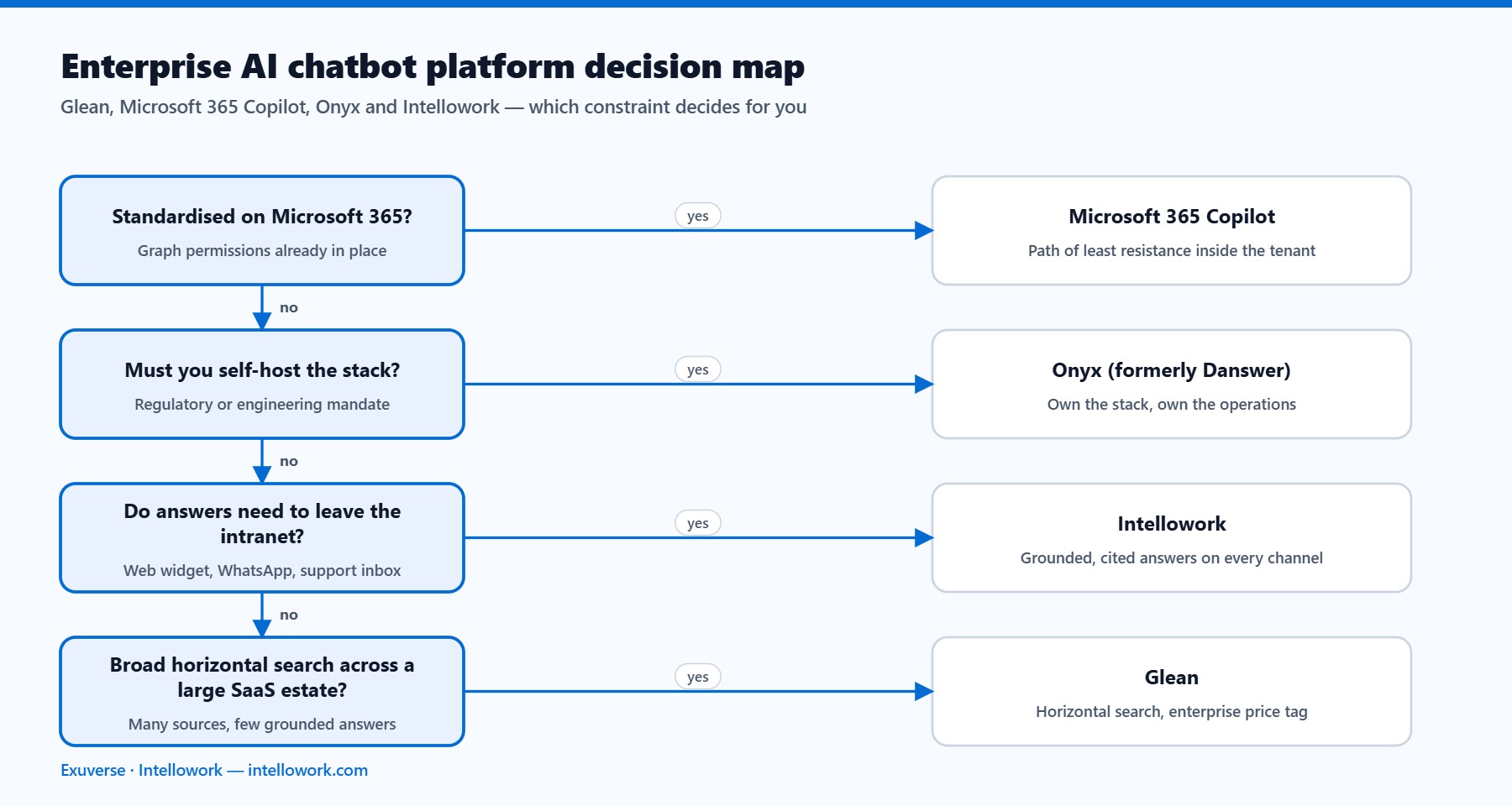
Rather than a scorecard, here is the decision in the form buying committees actually argue about.
- Knowledge is scattered across dozens of SaaS tools and nobody can find anything. That is a discovery problem. Glean, or Copilot if the estate is genuinely Microsoft-centric.
- Support tickets repeat the same forty questions. That is a deflection problem on a bounded corpus. A grounded assistant on your knowledge base and docs, exposed on the channels customers already use. Intellowork is built for this shape.
- Developers cannot get answers out of the product documentation. A documentation chatbot with strict citation behaviour. Accuracy and source linking matter far more than connector breadth.
- Data cannot leave your infrastructure under any circumstances. Onyx self-hosted, or a custom build. Accept the operational cost honestly rather than discovering it in month four.
- The requirement is drafting, summarising and meeting recall inside Office. Copilot. Nothing else is embedded where the work happens.
- Retrieval quality is the product you sell. Build. Anything else caps your ceiling.
The cost line items buyers consistently miss
Licence cost is the number in the business case. It is rarely the number that decides whether the project succeeds. Four others matter as much.
- Content remediation. Every deployment surfaces the same truth: the assistant is only as good as the documentation. Expect a real programme of work to retire stale pages, resolve contradictory policies and fix the permissions that were quietly wrong.
- Evaluation. A hundred to two hundred questions with agreed correct answers, maintained continuously. Without it you cannot tell an upgrade from a regression, and you will argue about vibes for a year.
- Inference cost at real volume. Pilot economics with fifty users mislead badly at five thousand. Model the token cost of your actual context window and retrieval depth, not the vendor’s example.
- Change management. An assistant nobody trusts gets one bad answer and is abandoned. Trust is built by citations, by honest refusals, and by a visible feedback loop. Our breakdown of AI chatbot development cost covers how these line items usually land.
A 30-day evaluation you can actually run
Do not run four parallel proofs of concept. Run one disciplined evaluation against a fixed corpus and a fixed question set, and make every vendor face the same test.
- Week one. Pick one corpus with a real owner. Write one hundred questions from actual tickets or search logs, with an agreed correct answer and source for each. Include ten questions the corpus genuinely cannot answer.
- Week two. Connect each shortlisted platform to that same corpus. Note how long ingestion takes and what breaks, because that is your future.
- Week three. Score every answer on three axes: correct, grounded in a citation you can open, and appropriately refused where refusal was right. The refusal score is the one that predicts production behaviour.
- Week four. Run the permission test. Create two accounts with different entitlements and ask each the same restricted question. Any platform that leaks here is disqualified regardless of how it scored elsewhere. Our note on role-based access in AI chatbots explains how to construct that test properly.
Frequently asked questions
What is the best enterprise AI chatbot platform in 2026?
There is no single best platform, because the four leading options solve different problems. Glean is strongest for horizontal discovery across a large SaaS estate. Microsoft 365 Copilot is strongest inside a Microsoft-standardised organisation. Onyx is strongest where self-hosting is mandatory. Intellowork is strongest where you need grounded, cited answers on a defined body of content delivered across many channels. Match the platform to the shape of your problem rather than to a feature count.
How much does an enterprise AI chatbot platform cost?
Pricing takes three shapes. Per-seat platforms such as Microsoft 365 Copilot list at thirty dollars per user per month on top of a qualifying Microsoft 365 plan. Quoted per-seat platforms such as Glean are commonly reported starting around fifty dollars per user per month with six-figure annual minimums. Per-workspace platforms such as Intellowork price by workspace with usage-based add-ons, which decouples cost from headcount. Open-source options such as Onyx have no licence cost but carry real infrastructure and engineering operating costs.
Do these platforms respect existing document permissions?
The mature ones do, but the mechanism differs and the difference matters. Copilot inherits Microsoft Graph permissions directly. Glean maintains permission-aware indexes per connector. Intellowork enforces source-level access control lists at retrieval time. Self-hosted deployments enforce whatever you configured. In every case the platform inherits your existing permission hygiene, so oversharing that already exists will be surfaced faster, not fixed.
Can an enterprise AI chatbot work without sending data to OpenAI?
Yes. Onyx can be pointed at a self-hosted model entirely inside your network. Intellowork supports bring-your-own keys across OpenAI, Anthropic, AWS Bedrock, Azure OpenAI and self-hosted OpenAI-compatible endpoints, with regional data residency. Microsoft processes data within its own commercial boundary rather than sending it to OpenAI’s consumer services. Confirm the specific commitment in writing, since the marketing language and the contractual language often differ.
How long does deployment take?
A first useful answer on a clean corpus takes days on any of these platforms. A production rollout takes six to twelve weeks, and almost all of that time goes to content remediation, permission verification and building the evaluation set, not to configuring the chatbot. Plan the schedule around those three activities.
What is the biggest cause of failed deployments?
Trust collapse. One confidently wrong answer in front of the wrong audience ends adoption faster than any feature gap. The defences are unglamorous and effective: verifiable citations, an assistant that refuses rather than guesses below a confidence threshold, and a visible feedback route that demonstrably leads to fixes.
The decision underneath the decision
Choosing between enterprise AI chatbot platforms is really choosing what you want to own. Buy a horizontal suite and you own the licence and the renewal. Self-host and you own the operations. Build and you own everything, including the parts nobody costed. There is no wrong answer, only answers that do not match the organisation making them.
What is not optional, whichever you pick, is the discipline underneath: hybrid retrieval, permissions enforced at retrieval time, citations a reader can open, an evaluation set that catches regressions, and observability good enough to explain a bad answer. Platforms that give you those are worth paying for. Platforms that do not are a demo with a contract attached.
If your problem is the second shape in this article — dependable, cited answers on your own content, delivered on the channels your users already use — that is precisely what we built Intellowork to do, and what our work on AI-powered enterprise search is grounded in. Access is invite-only while we stage onboarding, and you can request an invitation through the site.
About the author
Tarun Gupta is the founder and AI architect at Exuverse Private Limited, an AI and custom software development company in Noida, India. He designs and operates production retrieval-augmented generation systems on AWS Bedrock, Solr and pgvector, and is the architect behind Intellowork. This article reflects hands-on delivery experience with enterprise search and chatbot deployments rather than vendor briefings.
Last reviewed: 31 August 2026. Vendor pricing and capabilities change frequently; verify current terms directly with each vendor.