
Enterprise AI chatbot security stopped being a theoretical concern in 2026. Three clocks are now running at once: India’s Digital Personal Data Protection Rules moved from guidance to supervision this November, the EU AI Act’s transparency obligations took effect on 2 August, and GDPR enforcement against AI systems has quietly become routine. Meanwhile the technical risks have not gone anywhere — an assistant that retrieves documents on behalf of a user is, architecturally, a very fast way to move confidential text to whoever asks the right question.
This guide covers what actually has to be true for an enterprise AI chatbot to survive a security review and a regulator’s questions: the controls, the regulatory deadlines that apply to Indian and European operations, the failure modes that show up in real deployments, and a pre-launch checklist you can hand to an engineering team.
Engineers who build these systems wrote this article. It explains regulatory requirements as they affect system design; it is not legal advice. Confirm your specific obligations with qualified counsel before relying on any of it.
What enterprise AI chatbot security actually means
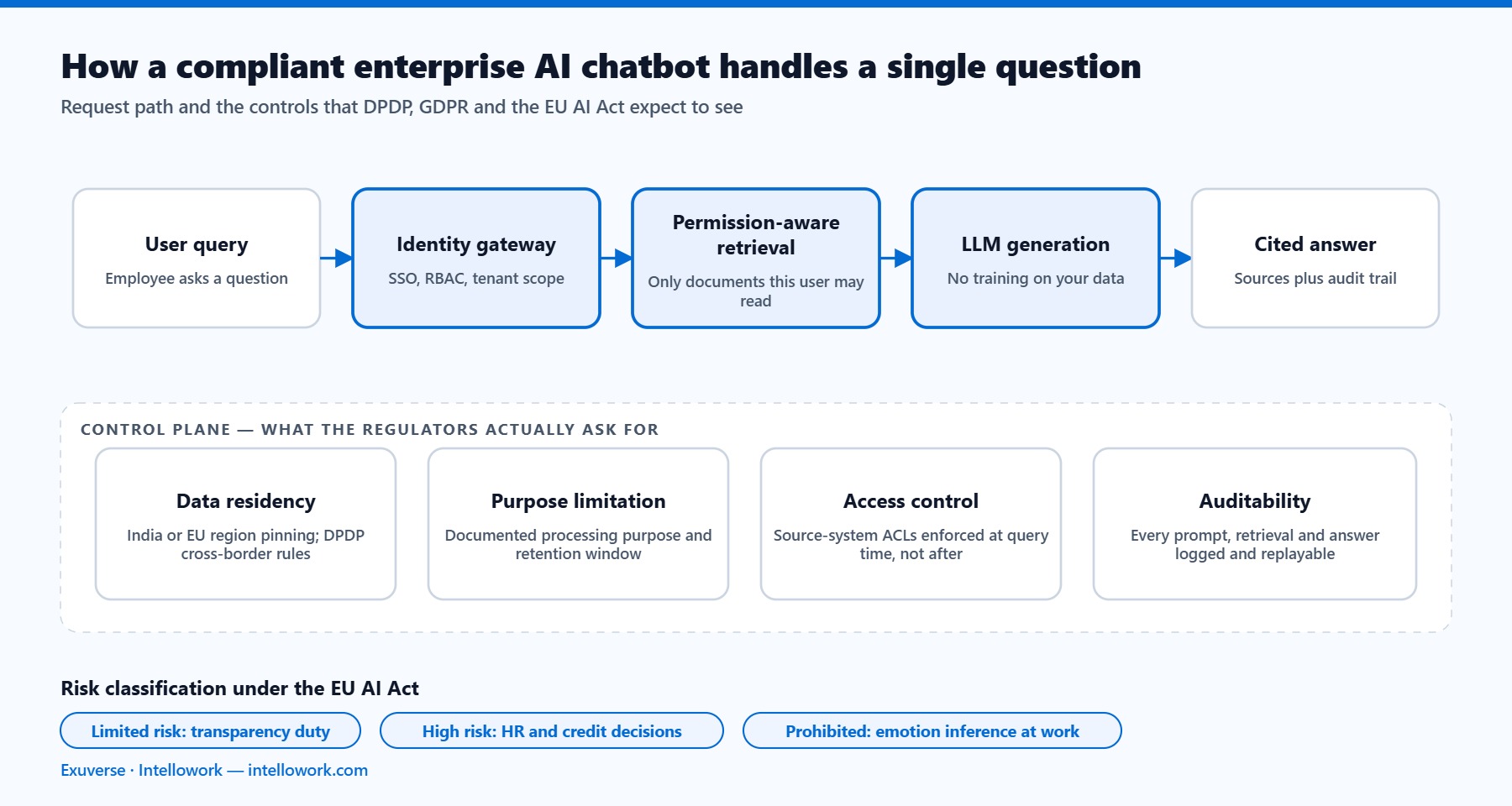
Enterprise AI chatbot security is the set of controls that ensure an AI assistant can only retrieve, use and disclose information that the person asking is entitled to see, that its answers can be traced back to their sources, that personal data flowing through it is processed lawfully and stored where you say it is, and that every one of those properties can be proved after the fact.
Note what that definition does not say. It is not about the model. Model choice matters for quality and cost, but almost every serious incident in enterprise deployments traces back to the layers around the model: an over-permissive index, a connector that ignored access control lists, a retention policy nobody configured, an agent given a tool it should never have had. The model is rarely the vulnerability. Its plumbing usually is.
The 2026 regulatory clock for enterprise AI chatbot security
If you operate in India, Europe, or both, three regimes now shape what you can ship. The dates matter because several of them fall within the next fifteen months.
India: the DPDP Act and the DPDP Rules
The government notified the Digital Personal Data Protection Rules on 14 November 2025, starting an eighteen-month phased transition. The consent manager ecosystem became operational through mid-2026. On 13 November 2026 the legacy data revalidation deadline arrives and the regulator’s posture shifts from guidance to active supervision: organisations must be able to show that personal data collected before the framework carries valid notice and consent. The first audit cycle for Significant Data Fiduciaries runs in the first quarter of 2027, and full adjudicatory enforcement begins around 13 May 2027, with penalties reaching 250 crore rupees.
For a chatbot, the operative consequences are concrete. Conversation transcripts containing personal data are personal data. Purpose limitation means you cannot quietly reuse support conversations to train a model unless the notice covered it. The right to erasure means you need a deletion path that reaches the transcript store, the vector index and the backups, not just the primary database.
Europe: GDPR
GDPR has applied to chatbots since the day they started handling personal data, and the obligations that bite hardest are unglamorous. You need a lawful basis for the processing and a notice that describes it. Article 28 requires a data processing agreement with the chatbot vendor and with any sub-processors, including model providers. Next comes Article 32, which requires security appropriate to the risk. Article 35 usually requires a data protection impact assessment, because an AI system processing employee or customer data at scale is close to the textbook trigger. Chapter V governs transfers outside the EEA, which is where the model provider’s location suddenly becomes a legal question rather than an architectural one. Penalties reach 20 million euros or four per cent of global annual turnover.
Europe: the AI Act, after the Digital Omnibus
This is the part most 2025-vintage compliance content now gets wrong. The Digital Omnibus regulation entered into force on 27 July 2026 and moved the high-risk deadlines: obligations for stand-alone Annex III high-risk systems now apply from 2 December 2027, and for Annex I product-embedded systems from 2 August 2028. The original 2 August 2026 high-risk date no longer applies.
AI Act deadlines that still bind an enterprise chatbot
What did not move is Article 50. Transparency obligations applied from 2 August 2026, which means a chatbot interacting with people in the EU must make clear that they are interacting with an AI system, unless that is obvious from context. Article 50(2) watermarking for synthetic content carries a grace period to 2 December 2026 for systems already on the market. Penalties under the AI Act reach 35 million euros or seven per cent of global turnover for prohibited practices, and 15 million euros or three per cent for most other breaches.
The practical reading for most enterprise assistants: your internal documentation chatbot is very unlikely to be high-risk. A chatbot used in recruitment screening, credit decisions, or access to essential services may well be. Classify deliberately and write the reasoning down, because the deferral gives you time to prepare, not permission to skip the analysis.
| Regime | Applies to | Key dates ahead | Maximum exposure |
|---|---|---|---|
| DPDP Act and Rules (India) | Any processing of digital personal data of people in India | 13 Nov 2026 legacy data revalidation; Q1 2027 SDF audits; ~13 May 2027 full enforcement | Up to 250 crore rupees |
| GDPR (EU/EEA) | Personal data of people in the EEA | Already in force | 20 million euros or 4% of global turnover |
| EU AI Act — Article 50 transparency | AI systems interacting with people in the EU | Applied 2 Aug 2026; watermarking grace to 2 Dec 2026 | 15 million euros or 3% of global turnover |
| EU AI Act — high-risk (Annex III) | Systems in listed high-risk domains | 2 Dec 2027, deferred by the Digital Omnibus | 15 million euros or 3% of global turnover |
Where enterprise AI chatbot security actually leaks
The OWASP Top 10 for Large Language Model Applications is the most useful shared vocabulary for this. Mapped onto a retrieval-augmented enterprise assistant, five of its entries account for nearly everything we see in the field.
- Sensitive information disclosure. Almost always a permissions failure rather than a model failure. A connector indexed a folder with inherited access nobody audited, and now the salary review spreadsheet is one well-phrased question away from the whole company.
- Prompt injection. Instructions hidden in retrieved content — a support ticket, a crawled web page, a PDF — that hijack the assistant’s behaviour. Indirect injection is the dangerous variant, because the attacker never talks to your chatbot at all. Our guide to prompt injection prevention covers the defences in depth.
- Excessive agency. The moment an assistant can call tools — raise a ticket, issue a refund, write to a CRM — a language failure becomes an action. Every tool needs its own authorisation boundary, not the model’s judgement.
- Vector and embedding weaknesses. The index is a second copy of your data with its own, usually weaker, access model. If permission checks happen after retrieval rather than inside it, the index is the leak.
- Misinformation. A confidently wrong answer about a policy, a dosage, a contract term or a configuration flag is a business risk whether or not a regulator ever hears about it.
Two of these deserve emphasis because they are consistently under-defended. Indirect prompt injection is under-defended because teams test the chat box and not the corpus. Teams under-defend excessive agency, because agentic features usually arrive after the security review closes.
Seven enterprise AI chatbot security controls that decide the review
1. A processing boundary you can name
You should be able to answer, in one sentence and without checking, where the index lives, which region processes inference, which sub-processors see document text, and whether any of them may retain it. Regional residency is a contractual and architectural commitment, not a marketing claim — ask for it in the data processing agreement. Platforms that support bring-your-own model keys or self-hosted endpoints let you keep inference inside a boundary you already control, which collapses a whole category of Chapter V transfer analysis.
2. Access control enforced at retrieval time
This is the control that matters most and the one most often faked. The correct behaviour filters the retrieval query itself against the requesting user’s entitlements, checking the source system’s access control list on every request. Filtering candidates after generation, or maintaining a nightly snapshot of permissions, both fail in predictable ways — the second one fails silently for up to twenty-four hours every time somebody changes role. Our note on role-based access in AI chatbots explains how to test this properly, and secure RAG on private data covers the index-level design.
3. Containment for injected instructions and tool use
Treat every retrieved passage as untrusted input, because it is. Practical measures: keep retrieved content structurally separate from system instructions rather than concatenated into one prompt; never let retrieved text authorise an action; require explicit confirmation for any tool call with a side effect; and scope each tool’s credentials to the narrowest possible permission rather than to a service account that can do everything. Enterprise AI guardrails are the layer that makes this enforceable rather than aspirational.
4. Retention, erasure and a training-data commitment in writing
Three questions, all of which need documented answers before launch. How long are conversation transcripts kept, and is that period defensible against your stated purpose? When a person exercises the right to erasure, does deletion actually reach the transcript store, the vector index, the analytics warehouse and the backups? And is there a contractual commitment that your content and conversations are not used to train anyone’s model? A vendor that will not put the third one in the agreement has answered the question.
5. Audit logs, the backbone of enterprise AI chatbot security
The test is not whether logs exist. It is whether, given a date and a person, you can reconstruct what was asked, which documents were retrieved, what was answered, and who changed the configuration that made it possible. That means logging retrieval decisions and configuration changes, not just chat text. It is also the foundation of ordinary operations — see LLM observability for internal AI assistants for how to make those logs useful rather than merely voluminous.
6. Grounding, citations and honest refusal
Security controls stop disclosure. Grounding controls stop invention, which is the other half of the risk. An assistant should answer only from retrieved passages, cite sources the reader can open, and refuse below a confidence threshold rather than improvise. Verifiable citations are simultaneously the strongest anti-hallucination control and the fastest way to build user trust, because a reader who can check an answer stops needing to trust the system in the first place.
7. Vendor due diligence for enterprise AI chatbot security
Ask for the sub-processor list and the notification period for changes to it. Ask which region processes inference, not just which region stores data. Check whether tenant isolation is logical or physical. Ask whether vendor staff can read tenant content, under what circumstances, and whether the platform logs that access. Ask for the data processing agreement before the pilot, not before the renewal. Our enterprise chatbot evaluation checklist and our comparison of enterprise AI chatbot platforms both include the questions worth asking.
Enterprise AI chatbot security: what Indian companies must do before November 2026
The 13 November 2026 milestone is the one Indian teams should be planning against, because it ends the soft-enforcement posture. For an organisation running a customer-facing or employee-facing assistant, the work divides cleanly.
- Inventory the personal data your assistant touches. Not just what users type — what the retrieval layer can reach. An assistant indexed over an HR share is processing personal data whether or not anyone intended it to.
- Fix the notice. The notice must describe the processing in plain language, including that an AI system processes the conversation, and it must stand on its own rather than hide inside a general privacy policy paragraph.
- Build the erasure path and test it. A deletion request must remove the transcript, the derived embeddings and any analytics copy. Run the test end to end and keep the evidence.
- Revalidate legacy data. Historic support conversations used to seed a knowledge base are legacy personal data. Either establish valid consent or remove them from the corpus.
- Check whether you are a Significant Data Fiduciary. If so, the first audit cycle in early 2027 requires an appointed auditor, a data protection impact assessment and documented governance. That is a two-quarter programme, not a two-week one.
The pre-launch enterprise AI chatbot security checklist
Twelve items. If any answer is uncertain, the assistant is not ready for the audience you are about to give it.
- Two test accounts with different entitlements return different answers to the same restricted question.
- A document removed from the source system stops appearing in answers within a defined, measured interval.
- Every answer carries citations the reader can open, and the cited passage genuinely supports the claim.
- The assistant refuses, rather than improvises, on questions the corpus cannot answer, and a fixed question set measures how often it does so.
- Instructions embedded inside a retrieved document do not change the assistant’s behaviour. Test this with a deliberately poisoned document.
- Every tool with a side effect requires confirmation and runs under narrowly scoped credentials.
- The contract states data residency for both storage and inference, not just a web page.
- A signed data processing agreement exists, with a current sub-processor list and a change-notification period.
- A written commitment exists that your content and conversations are not used to train third-party models.
- Retention periods run per data type, and a scheduled job that somebody owns actually enforces them.
- Audit logs cover retrieval decisions and configuration changes, not only conversation text.
- Users interacting from the EU are told they are talking to an AI system, satisfying Article 50.
Frequently asked questions
Is an internal AI chatbot high-risk under the EU AI Act?
Usually not. A documentation or IT helpdesk assistant generally falls outside the Annex III high-risk categories. It becomes high-risk when it is used in a listed domain such as recruitment and candidate screening, worker management decisions, creditworthiness assessment, or access to essential public services. Following the Digital Omnibus, Annex III high-risk obligations now apply from 2 December 2027, but the classification analysis should be documented now.
Does the DPDP Act apply to a chatbot hosted outside India?
Yes, where the processing relates to offering goods or services to people in India. Hosting location does not determine applicability. It does, however, determine how much cross-border transfer analysis you have to do, which is one reason regional data residency is worth insisting on at procurement rather than retrofitting later.
Can we use ChatGPT or Claude in an enterprise chatbot and stay compliant?
Generally yes, provided you use the enterprise or API tiers with the appropriate data processing agreement, confirm the processing region, and rely on the contractual commitment that inputs are not used for training. The consumer products are a different matter and should not touch personal data. The controls that make this defensible are the same either way: a signed agreement, a named region, a sub-processor list and audit logs.
What is the most common security failure in enterprise chatbot deployments?
Inherited oversharing. The chatbot does not create the problem; it makes a decade of permissive folder permissions instantly searchable in natural language. Run a permissions audit on the corpus before connecting anything, and treat whatever the assistant surfaces in week one as a finding rather than a bug.
How do we stop prompt injection from documents we do not control?
You reduce it rather than eliminate it. Keep retrieved content structurally separated from instructions, never allow retrieved text to authorise an action, require confirmation for side-effecting tools, scope tool credentials narrowly, and monitor for anomalous tool-call patterns. Test with deliberately poisoned documents in your evaluation set so regressions are caught before users find them.
Do we need a DPIA for an internal AI assistant?
Under GDPR, usually yes where the assistant processes employee or customer personal data at scale, and it is difficult to argue otherwise for a system with broad access to internal records. Under the Indian framework, a data protection impact assessment is an explicit obligation for Significant Data Fiduciaries. Even where it is not strictly required, the exercise surfaces the permission and retention gaps that cause incidents.
Security is a design property, not a launch checklist
Every control in this article is cheaper to build in than to retrofit. Retrieval-time access enforcement is a design decision made in week one or an architecture rewrite in month nine. Erasure that reaches the vector index is trivial if the index carries document identity and nearly impossible if it does not. Audit logs that answer a regulator’s question require you to log retrieval decisions from the start, because you cannot reconstruct them later.
The regulatory deadlines are useful mainly as a forcing function. The underlying discipline — know your processing boundary, enforce permissions where retrieval happens, ground every answer in a source the reader can open, log enough to explain yourself — is what makes an assistant trustworthy regardless of which regime is asking. Our broader analysis of enterprise AI security risks and solutions covers the wider programme this sits inside.
We built Intellowork around these constraints rather than bolting them on: source-level access control lists enforced at retrieval, citations on every answer, confidence thresholds that produce refusals instead of invention, audit logging on configuration changes, regional data residency with ap-south-1 as the default and EU or US on request, and bring-your-own model keys including self-hosted endpoints. Access is invite-only while onboarding is staged.
About the author
Tarun Gupta is the founder and AI architect at Exuverse Private Limited, an AI and custom software development company in Noida, India. He designs and operates production retrieval-augmented generation systems on AWS Bedrock, Solr and pgvector, is the architect behind Intellowork, and works alongside the team behind ProtectComply on Indian data protection tooling.
Last reviewed: 31 August 2026. Regulatory timelines described here reflect the position as of that date, including the Digital Omnibus regulation that entered into force on 27 July 2026. This is general information for system designers and not legal advice.