What It Actually Takes to Build an “AI Employee”: The Engineering Behind the Hype
Every pitch deck this year has an AI employee slide. However, very few have the engineering bill of materials behind it.
We build these systems. Below, here is what an “AI employee” is made of when the demo ends and production begins.
Ingredient 1: Company Context (the Hard 80%)
What makes an AI employee useful is not the model — it is grounding in your policies, products, and systems. In practice, that means a retrieval layer over your real content: connectors, chunking, embeddings, hybrid search, reranking, and ACLs enforced in the index. Overall, this is 80% of the engineering and 100% of the trust. Our enterprise RAG systems guide is the deep dive.
Ingredient 2: Bounded Tools, Not Open Autonomy
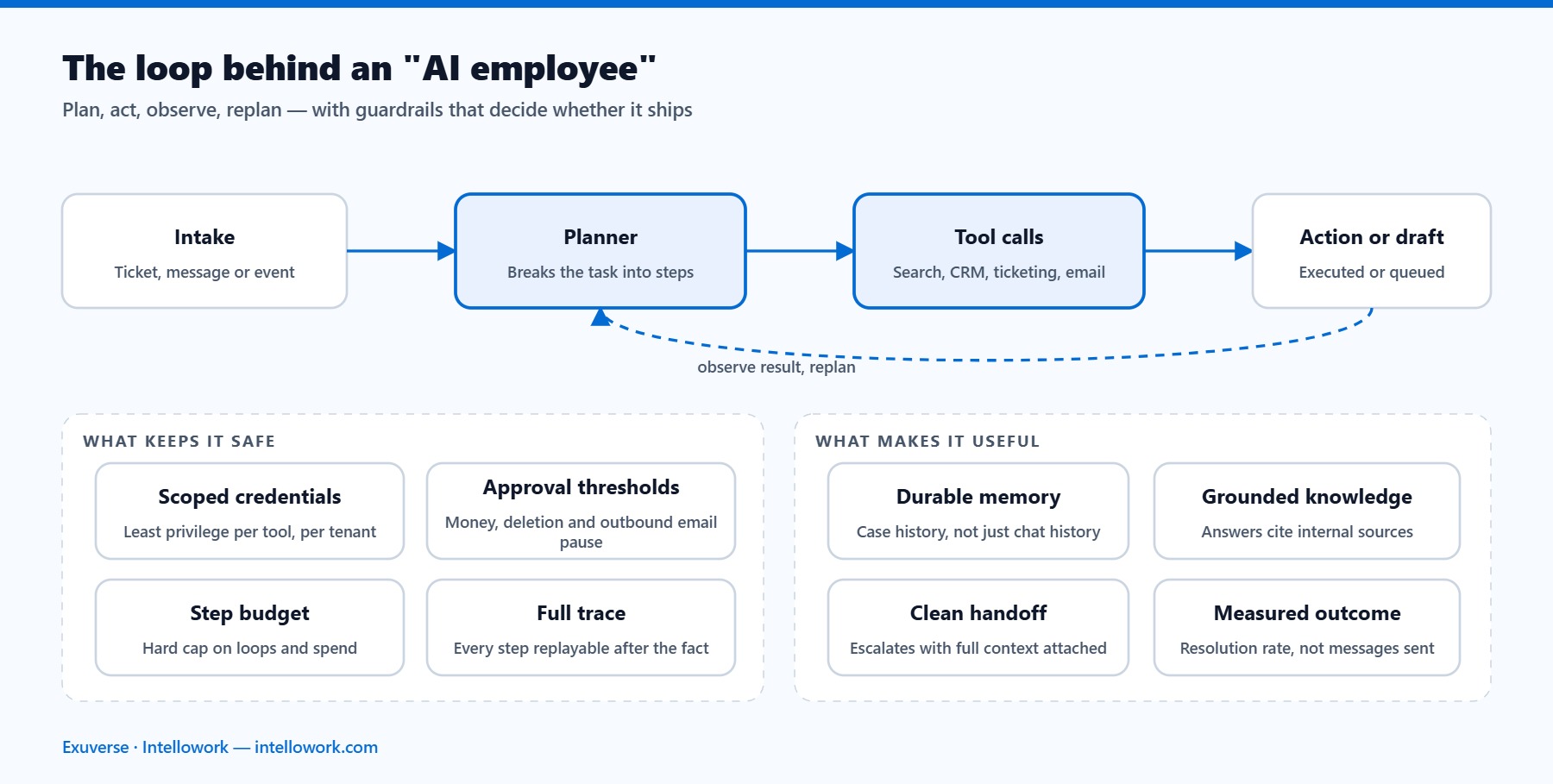
The “doer” half — looking up orders, filing tickets, updating records — is tool-calling against your APIs with three non-negotiables: idempotent operations, confirmation before any write, and identity flowing from SSO so the agent acts as the user, never above them. We cover the agentic patterns in Solr integration with agentic AI.
Ingredient 3: An Honesty Layer
Citations on every answer. Confidence thresholds that trigger “I am not sure” instead of fabrication. Logging of every retrieval and every tool call. As a result, without this layer you have not built an employee — you have built an unaccountable intern with admin access.
Ingredient 4: Presence Where Work Happens
Furthermore, an AI employee that lives in one browser tab gets forgotten. Instead, production systems deliver the same grounded brain to Slack, Teams, WhatsApp, and the web — one pipeline, per-channel presentation.
The Build Estimate Nobody Puts on the Slide
A credible v1 of the above — ingestion, ACL-aware retrieval, honesty layer, two channels — is a multi-engineer, multi-month effort, plus permanent ownership. Our chatbot development cost guide puts numbers on it, and the build vs buy framework tells you honestly which side of the line you are on.
If your requirement is the standard shape, the ingredients are already assembled: IntelloWork — built by this team — ships the grounded answerer with citations, ACLs, SSO, and four channels, with transactional flows for the doer stage. The buyer’s view of the same concept: AI employees for business.
Where AI employee projects break first
The demo is never the problem. Every one of these systems demos beautifully, because a demo runs on curated context, a happy-path question and no permission model. Breakage arrives in a predictable order.
- Week two: the context turns out to be wrong. For example, two versions of the process document sit live and disagree. The AI employee is not confused — it is faithfully reporting a contradiction the organisation had been quietly tolerating in humans.
- Week four: someone asks something adjacent. Slightly outside the designed scope, and the system answers anyway, plausibly and wrongly. Therefore, without a confidence floor, scope is only a suggestion.
- Week six: a tool call does something it should not. For instance, a ticket lands against the wrong project, or a record changes on a misread. Typically this is not a model failure, but a missing confirmation step on a side-effecting action.
- Week ten: the permission question. Someone realises the assistant can read a folder it should not, and the project pauses for a permissions audit nobody scheduled.
Notably, each of these is cheap to design against and expensive to retrofit, which is the recurring theme of every honest account of this work.
Scope is the design decision, not the model
The phrase “AI employee” invites the wrong mental model, because a human employee has judgement about the edges of their own competence. A language model does not, and cannot be prompted into having it reliably. What substitutes for that judgement is explicit scope, expressed in three places at once.
- In retrieval. The corpus defines what the system can know. A narrow, well-maintained corpus outperforms a broad, stale one every time.
- In the confidence floor. Below a threshold, the system says it does not know and hands off. This is the single highest-leverage control in the whole design.
- In tool permissions. Each tool gets its own narrowly scoped credential and, where the action has a side effect, a confirmation step. The model proposes; the authorisation layer disposes.
Together these turn an open-ended agent into something you can reason about, and they are the same controls that make the system defensible in a security review — see our guide to enterprise AI chatbot security for how excessive agency is treated as a risk category in its own right.
A realistic ninety-day plan
- Days 1 to 15: pick one job, not a role. “Answer tier-one questions about the returns policy” is a job. By contrast, “handle customer support” is a role and will fail. Next, write one hundred real questions with agreed answers.
- Days 16 to 40: fix the context. Then retire contradictory documents, correct the permissions, and get the corpus into a state where a careful human could answer every test question from it. Indeed, this is the eighty per cent of the work.
- Days 41 to 60: build retrieval, citations and the confidence floor. No tools yet. Get grounded, cited, honest answers first.
- Days 61 to 75: add one tool. After that, add the single highest-value action, with confirmation and scoped credentials. Measure how often the agent proposes it correctly before you add a second.
- Days 76 to 90: put it where the work happens. That means Slack, Teams, WhatsApp or the helpdesk — not a portal nobody opens. Finally, instrument everything and make the feedback route visible.
Ninety days of this produces something narrow that works, and that you can then widen. Meanwhile, ninety days of building a general-purpose AI colleague produces only a demo.
Frequently asked questions
What is an AI employee?
An AI employee is a marketing term for an AI agent that performs a defined set of work tasks end to end — answering questions from company context, and taking bounded actions in business systems — rather than only generating text. In engineering terms it is a retrieval-augmented assistant with a tool layer, an authorisation boundary and a confidence floor.
Can an AI employee replace a headcount?
Realistically it absorbs the repetitive fraction of a role rather than the role. The measurable win is deflection — questions and tasks resolved without a person — which is worth quantifying honestly, because it is usually substantial and usually smaller than the pitch deck claims.
How much does it cost to build one?
The engineering is rarely the dominant cost; context preparation and ongoing ownership are. A useful rule of thumb is that content remediation, evaluation and maintenance together outweigh the initial build within the first year. Our build versus buy analysis and cost breakdown set out the line items.
What is the difference between an AI employee and a chatbot?
Scope of action. A chatbot answers; an AI employee also acts, which is why the authorisation boundary around its tools matters more than the quality of its prose. The retrieval layer underneath is the same in both cases, and it is still what determines whether either is trustworthy.
Written by Tarun Gupta, founder and AI architect at Exuverse and the architect behind Intellowork. Last reviewed 31 August 2026.