A multilingual AI chatbot sounds like a translation problem. In practice, it is a retrieval problem wearing a translation costume. Your documents sit in English. Your customers ask in Hindi, in English, and very often in both at once. The model can produce fluent Hindi easily, so that part rarely fails. Finding the right paragraph from a Hinglish question is where systems quietly break.
This guide covers what actually has to work. It looks at scripts and transliteration, at code-mixing, at the four common architectures, and at how to evaluate any of it honestly. Indian deployments get particular attention, because that is where we build and operate these systems.
Why “multilingual” usually means English with a translate button
Many products claim multilingual support. Look closely and the pattern repeats. The system translates the question into English, searches an English index, then translates the answer back. That approach works for simple queries, and it fails in three predictable ways.
First, translation loses domain terms. A support query about a “recharge plan” or a “policy lapse” carries meaning that generic translation flattens. Second, transliterated text confuses the translator, because “kya mera plan active hai” is neither clean Hindi nor English. Third, the round trip adds latency and hides errors, so nobody can tell whether retrieval or translation failed.
A serious multilingual AI chatbot therefore treats language as a property of every stage, not as a wrapper around the outside. We made a similar argument about retrieval quality in our post on hybrid search architecture.
What a multilingual AI chatbot has to solve
Script variation
Hindi arrives in two scripts. Some people type Devanagari. Many more type Roman characters, because the keyboard is faster. Both must reach the same answer. Consequently, your pipeline needs script detection and normalisation before retrieval, not after.
Code-mixing
Real questions blend languages inside a single sentence. “Mera invoice download nahi ho raha” mixes Hindi grammar with English nouns. Language identification then returns a confused result, and naive routing sends the query to the wrong pipeline. So treat code-mixing as the default case rather than an edge case.
Domain vocabulary
Every business has words that translation engines mangle. Product names, plan tiers, internal jargon and regional spellings all qualify. Therefore you need a glossary that survives every stage, including embedding and reranking. Without it, the assistant sounds fluent and answers the wrong question.
Why retrieval is the hard part of a multilingual AI chatbot
Generation gets the attention because it is visible. Retrieval decides accuracy. When someone asks in Hinglish and your corpus is English, the embedding has to place both in nearby space. Multilingual embedding models do this reasonably well for clean text. They struggle with transliteration and heavy code-mixing.
Keyword search struggles too, though differently. Exact terms are its strength, yet “invoice” spelled as “invoyce” or written in Devanagari never matches. As a result, neither method alone is enough, and hybrid retrieval becomes essential rather than optional.
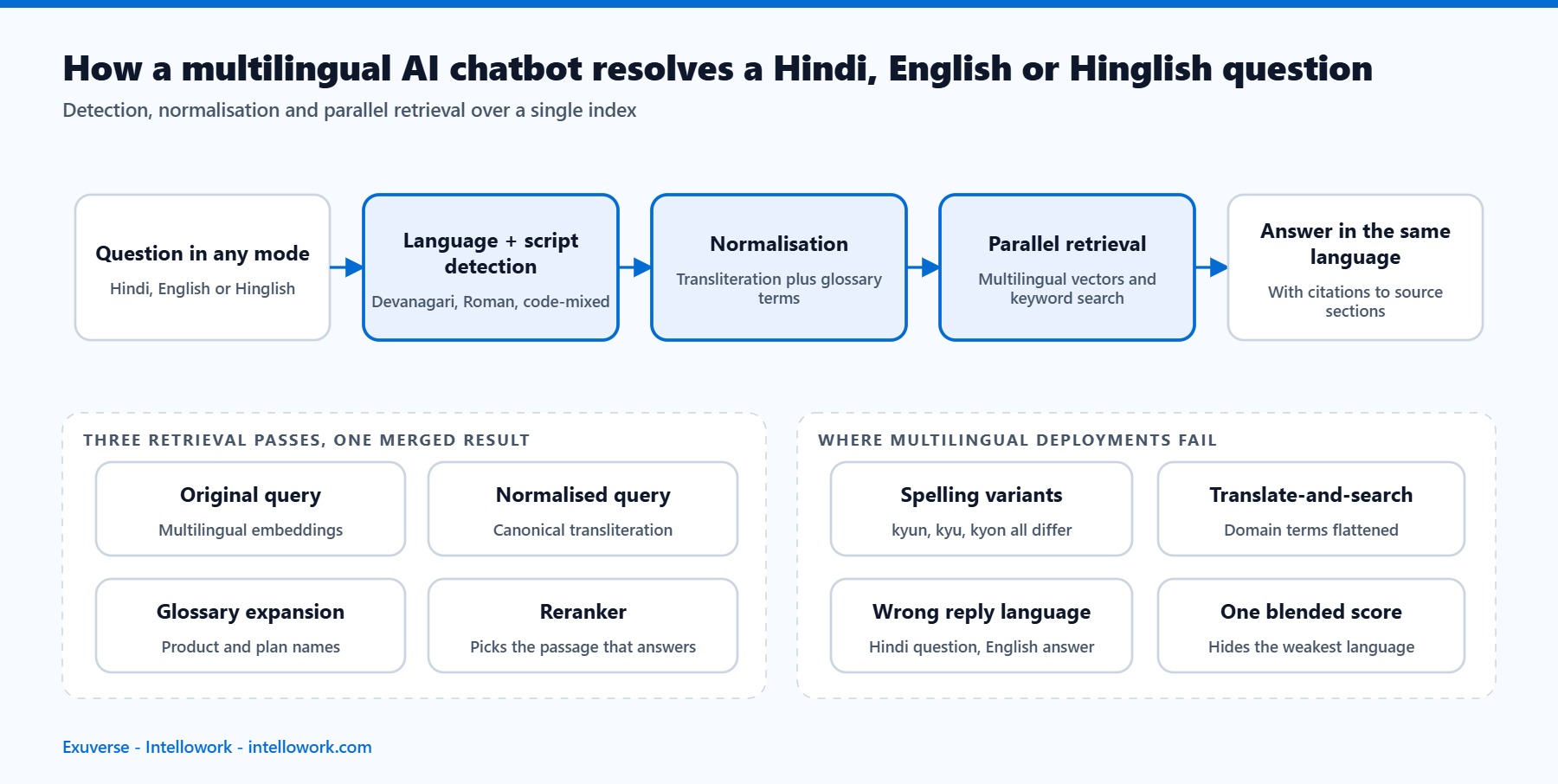
A practical multilingual AI chatbot therefore runs several retrievals and merges them. One pass uses multilingual embeddings on the original query. Another uses a normalised, transliterated form. A third expands the query with glossary terms. Reranking then picks the passages that genuinely answer the question.
Four multilingual AI chatbot architectures, and when each fits
There is no single right design. Instead, there are four common ones, each with a clear sweet spot.
- Translate the query. Cheapest to build. Works when questions are short and the corpus is clean English. Breaks on code-mixing.
- Translate the corpus. Index every document in each supported language. Retrieval quality improves, yet storage, cost and drift all multiply.
- Multilingual embeddings. One index, many languages. Elegant and usually the strongest starting point. Still weak on transliteration without normalisation.
- Hybrid with normalisation. Multilingual embeddings, plus transliteration, plus a glossary, plus keyword search. More moving parts, and the best accuracy in production.
Most teams begin with option one because it ships in a week. Then, once real traffic arrives, they discover the Hinglish gap. Moving to option four later is normal, so design your evaluation set early enough to prove the improvement.
Transliteration: the Hinglish problem in detail
Transliteration deserves its own section, because it causes more failures than any other single factor in Indian deployments.
People spell the same word many ways. “Kyun”, “kyu” and “kyon” all appear. Names vary even more. Consequently, exact matching fails, and fuzzy matching over-matches.
Three techniques help together. First, normalise transliterated input to a canonical form before embedding. Second, index both the original and the normalised text, so keyword search has something stable to hit. Third, keep a synonym map for the twenty or thirty terms your business uses constantly.
That last step feels unglamorous. Even so, it usually delivers the largest accuracy jump in the first month, and it costs an afternoon of work.
How to evaluate a multilingual AI chatbot honestly
English benchmarks tell you very little here. Build your own set instead, and keep it small enough to maintain.
- 60 questions per language mode. Clean Hindi, clean English, and code-mixed. Use real questions from your support inbox.
- Known answers. Each question maps to a specific document and section, so scoring stays objective.
- Spelling variants. Include three transliteration spellings for your ten most common terms.
- Refusal cases. Questions your corpus cannot answer, in every language mode.
- Answer-language checks. The reply should match the language the person used, unless they ask otherwise.
Score retrieval separately from generation. Otherwise a fluent wrong answer looks like a model problem when it is really a retrieval problem. Our guide to evaluating RAG system performance covers the scoring mechanics in more depth.
Channels where a multilingual AI chatbot matters most
Language choice is not evenly distributed across channels. Website visitors often type English. WhatsApp users switch to Hinglish immediately, because the medium feels informal. Voice callers use whichever language they speak at home.
So the channel shapes the requirement. A multilingual AI chatbot on WhatsApp needs strong transliteration handling above all. On voice, speech recognition quality dominates, and accented English creates as many errors as Hindi does.
Keep one retrieval layer across all of them. Otherwise you end up tuning three systems and explaining three different answers to the same question. We covered the shared-brain principle in our post on custom AI chatbots for business websites.
Compliance and residency for Indian language data
Language data is personal data more often than teams expect. Voice recordings, chat transcripts and support tickets all carry identifiers. Therefore the same rules apply as anywhere else.
Under the Digital Personal Data Protection Act, purpose limitation and retention matter, and cross-border transfer rules apply to the region you choose. For a multilingual AI chatbot, two extra questions come up. Where does speech recognition run, and where do translation calls go? Both can quietly move content outside your chosen region.
Ask vendors to name every sub-processor in the language path. Then write the answer into your data-flow note. We set out the wider mapping in enterprise AI chatbot security and compliance.
A 30-day multilingual AI chatbot plan that produces evidence
- Days 1 to 5. Pull 300 real questions from support. Label them by language mode.
- Days 6 to 10. Build the evaluation set and the glossary. Both stay small and useful.
- Days 11 to 16. Ship multilingual embeddings with hybrid retrieval. Measure baseline accuracy per mode.
- Days 17 to 22. Add transliteration normalisation and synonym expansion. Measure again.
- Days 23 to 30. Pilot on one channel, review refusals weekly, then publish the numbers internally.
Publishing the numbers matters more than the numbers themselves. Because stakeholders can see accuracy per language, the conversation moves from opinion to evidence.
Common multilingual AI chatbot mistakes
Teams often add languages before fixing retrieval in one. That multiplies the problem instead of solving it. Start with two modes, prove them, then extend.
Another frequent error is answering in the wrong language. If someone writes in Hindi, reply in Hindi. Mirroring the user feels obvious, yet plenty of deployments still reply in English by default.
Finally, avoid machine-translating your entire knowledge base as a first move. Translation drift is real, and nobody reviews 4,000 translated pages. Translate the twenty pages people actually ask about, and keep them reviewed.
What your knowledge base needs before you add languages
Retrieval can only be as good as the corpus underneath it. Multilingual work exposes content weaknesses that English-only usage hides.
Start by fixing structure. Long pages with no headings retrieve badly in any language, and they retrieve terribly across languages. Split them, add clear headings, and keep one topic per section. Because chunks inherit their headings, that single change lifts accuracy noticeably.
Next, remove contradictions. Two pages describing the same refund policy differently will produce two different answers, and users will notice faster when the answers arrive in their own language. Consolidate first, then index.
Finally, mark authority. Tag the canonical page for each topic, and let retrieval prefer it. A multilingual AI chatbot that keeps quoting an old draft loses trust quickly, and rebuilding that trust takes months.
Voice: where accuracy actually drops
Text pipelines get most of the attention, yet voice is where Indian deployments meet their hardest test. Speech recognition introduces errors before retrieval even starts.
Accents vary widely across regions, and background noise is common on mobile calls. Consequently, a transcript may contain the right intent with the wrong words. Retrieval then fails, and the caller hears a confident non-answer.
Two habits help. First, feed the recogniser a domain vocabulary list, because product names and plan tiers are exactly what it mishears. Second, design a confirmation step for high-stakes intents, such as payments or cancellations. A short “did you mean” saves a long escalation.
Also measure voice separately. A multilingual AI chatbot can look excellent on text and mediocre on calls, and a blended score hides that gap entirely.
Governance: who reviews answers in each language
Someone has to own quality per language. Without a named reviewer, errors accumulate quietly, because English-speaking teams cannot spot a wrong Hindi answer.
Set up a weekly review of twenty sampled conversations per language. Keep it short and consistent. Then route findings into two buckets: content fixes and retrieval fixes. Most issues turn out to be content problems, which is good news, since content is easier to change than models.
Choosing which languages to support first
Language selection often happens by intuition. Data works better. Pull six months of support tickets, chats and call transcripts, then count language modes by volume and by resolution time.
Two patterns usually appear. One language mode carries most of the volume, and a second carries the slowest resolutions. Start with those two, because the first proves scale and the second proves value.
Regional expansion can then follow demand rather than ambition. Add one language, run it for a month with a native reviewer, and only then add the next. Teams that add five languages at once end up with five mediocre experiences and no way to tell which fix helped.
What good looks like after six months
Early wins are easy to fake. Sustained quality is not, so it helps to know what a healthy deployment looks like once the novelty has passed.
Answer rates hold steady across language modes rather than drifting apart. If English sits at 78 percent and Hinglish at 41 percent, the system is English-first with a translation layer, whatever the marketing says. Close gaps of more than ten points before adding scope.
Refusals stay visible and stable. A healthy assistant says “I could not find this” a few percent of the time, in every language. When refusals fall to zero, the model has started guessing, and someone will find out the hard way.
Escalations carry context. When a conversation moves to a human, the agent should see the original language, the transcript and the documents already retrieved. Otherwise the customer repeats themselves, and the assistant becomes a speed bump rather than a shortcut.
Content improves because of the assistant. Gap reports should turn into documentation tickets each month. That feedback loop is the quiet compounding benefit, and it outlasts any individual model choice.
Finally, cost per resolved question trends down. Volume grows, yet retrieval gets sharper and prompts get shorter. A mature multilingual AI chatbot becomes cheaper per answer over time, not more expensive.
Where Intellowork fits
Intellowork runs a multilingual AI chatbot on one retrieval layer across the web widget, WhatsApp, Instagram, Messenger, Slack, Teams and voice. Queries in Hindi, English or Hinglish hit the same index, and answers mirror the language the person used.
Transliteration normalisation and glossary expansion ship as part of retrieval rather than as bolt-ons. Answers carry citations to the source section, so reviewers can check a Hindi answer against an English document quickly. Hosting runs in ap-south-1 by default, which keeps residency discussions short for Indian deployments.
If you would rather build this yourself, that can make sense. Our note on build versus buy for an enterprise AI chatbot sets out the conditions honestly.
Frequently asked questions
Does a multilingual AI chatbot need a separate index per language?
Usually not. Multilingual embedding models let one index serve several languages. Separate indexes only help when a language has a large, genuinely distinct corpus, and they add maintenance cost that most teams do not need.
How well does a multilingual AI chatbot handle Hinglish?
Out of the box, moderately. With transliteration normalisation, a synonym map and hybrid retrieval, accuracy improves sharply. Test it with your own spellings, because performance varies by domain vocabulary.
Should the answer always match the question language?
Yes, by default. Mirroring the user reduces friction and builds trust. Offer a simple control to switch, since some professional users prefer English answers even when they ask in Hindi.
Can it work for regional languages beyond Hindi?
Yes. Tamil, Telugu, Bengali, Marathi and Gujarati all work with the same pattern. However, evaluation effort grows with each language, so add them one at a time and keep a native reviewer in the loop.
What does a multilingual AI chatbot cost to run?
Running costs rise modestly, mainly through longer prompts and extra retrieval passes. Storage stays flat when you use one multilingual index. Our breakdown of AI chatbot development cost in India lists the recurring items.
The takeaway
Language support is not a switch you turn on. It is a property of retrieval, and it shows up in the least glamorous places: spellings, glossaries and evaluation sets.
Start with two language modes and 60 real questions. Add transliteration normalisation before you add another language. Mirror the language your user chose, and cite sources every time, because trust is harder to earn across languages.
Do that, and a multilingual AI chatbot stops being a demo feature and becomes the way your customers actually reach answers. If you would like to see it on your own content, Intellowork can be evaluated on a small corpus in a fortnight.
About the author
Tarun Gupta is the founder and AI architect at Exuverse Private Limited, an AI and custom software development company in Noida, India. He designs and operates production retrieval-augmented generation systems on AWS Bedrock, Solr and pgvector, and he is the architect behind Intellowork.
Last reviewed: 1 September 2026.
Read next: Language work pays off on messaging too. See how it applies in our guide to the WhatsApp AI chatbot.