
Most AI chatbot ROI decks fall apart in the second meeting. The pilot reports a headline deflection figure, finance asks how it was counted, and the answer turns out to be every conversation the bot did not hand over. That includes the customers who gave up.
Fortunately, there is a better way to build the case. It starts with resolution rather than deflection, it uses a fully loaded cost per ticket, and it subtracts the content work honestly. This guide walks through the formulas, the benchmarks and a worked example you can adapt.
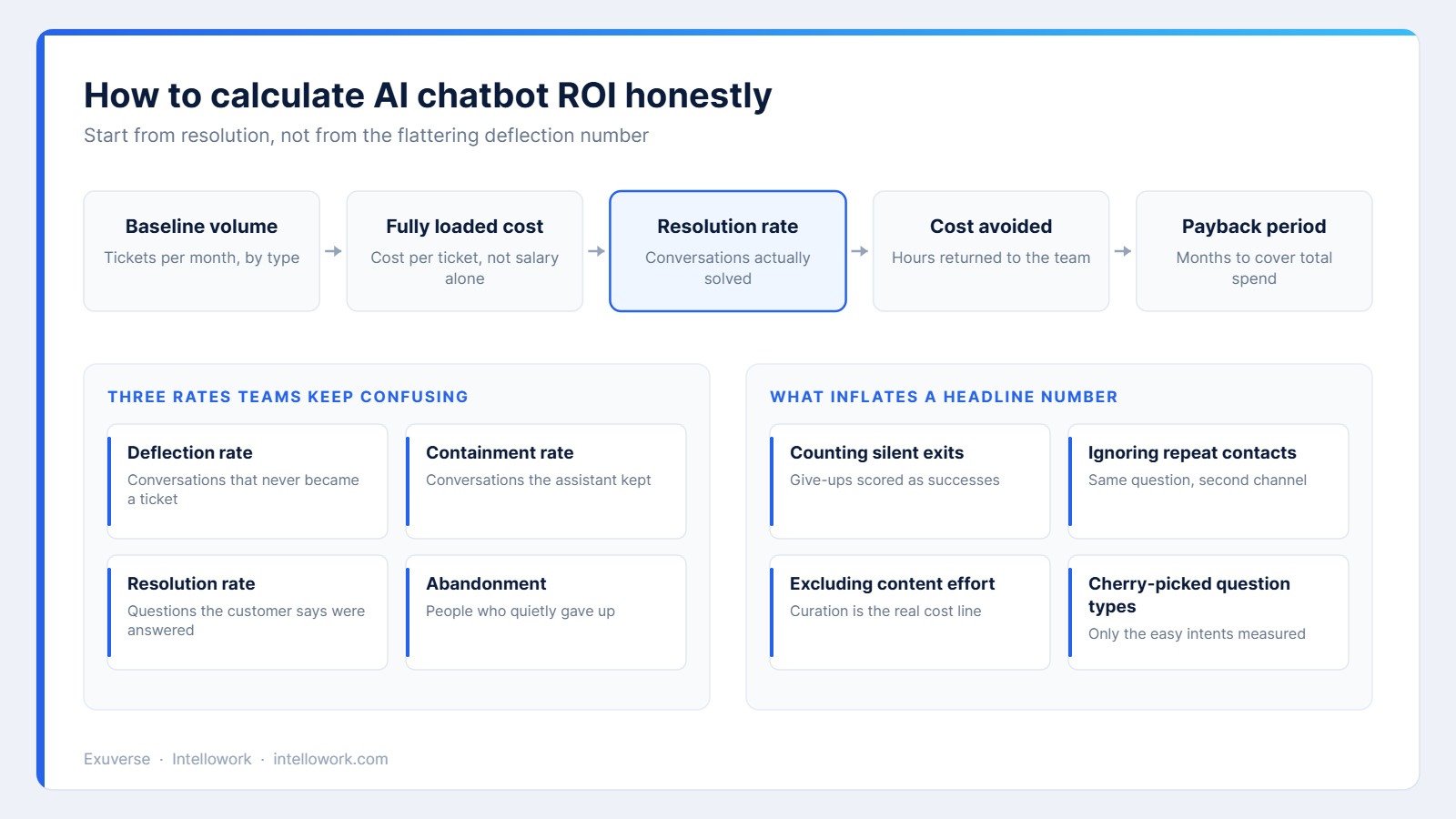
Why AI chatbot ROI arguments fall apart in review
At first, the usual claim sounds impressive. Sixty percent of conversations never reached an agent, so sixty percent of support cost disappeared. Unfortunately those two numbers are not linked.
In practice, agents rarely leave when volume drops. Instead they absorb the harder cases, which take longer. So the saving shows up as capacity, deferred hiring or extended hours, and each of those needs its own line. In addition, the questions a bot answers first are the cheapest ones, which means the average saving per deflected conversation is lower than the average cost per ticket.
Deflection, containment and resolution are not the same thing
These three words get used interchangeably, although they measure different events. Getting them straight is the first step to a defensible number.
| Metric | What it counts | Why it misleads |
|---|---|---|
| Deflection rate | Conversations that never became a ticket | Counts people who abandoned the channel |
| Containment rate | Conversations the assistant kept end to end | Rewards refusing to escalate |
| Resolution rate | Questions the customer confirms were answered | Harder to measure, but honest |
| Repeat contact rate | The same person asking again within a week | Reveals hollow resolutions |
The AI chatbot ROI formula that survives scrutiny
First of all, keep the arithmetic boring. A reviewer should be able to reproduce it on paper.
- Annual benefit equals resolved conversations multiplied by fully loaded cost per ticket.
- Annual cost equals platform fees plus integration effort plus content and evaluation time.
- Return equals annual benefit minus annual cost, divided by annual cost.
- Payback equals total first-year cost divided by monthly benefit.
Notice that resolved conversations, not deflected ones, drive the benefit. Because of that single substitution, most inflated business cases shrink by roughly a third, and the remainder holds up.
Start with a fully loaded cost per ticket
Unfortunately, salary alone understates the number badly. A support ticket carries tooling, quality assurance, training, supervision and attrition cost as well.
| Component | Typical share | Notes |
|---|---|---|
| Agent salary and benefits | 55 to 65 percent | Loaded, not base pay |
| Supervision and quality | 10 to 15 percent | Team leads, coaching, audits |
| Tooling and licences | 8 to 12 percent | Helpdesk, telephony, analytics |
| Hiring and training | 8 to 12 percent | Rises sharply with attrition |
| Facilities and overhead | 5 to 10 percent | Lower for remote teams |
A worked AI chatbot ROI example
For example, take a support team handling 20,000 tickets a month at a fully loaded cost of Rs 95 per ticket. After tuning, the assistant resolves 42 percent of inbound conversations, and sampling confirms that resolution rather than abandonment.
| Line | Calculation | Annual figure |
|---|---|---|
| Resolved conversations | 20,000 x 42 percent x 12 | 100,800 |
| Gross benefit | 100,800 x Rs 95 | Rs 95.8 lakh |
| Platform and usage | Subscription plus model cost | Rs 14 lakh |
| Content and evaluation | Half a role, ongoing | Rs 6 lakh |
| Integration build | One-off, first year | Rs 8 lakh |
| Net benefit | Benefit minus all cost | Rs 67.8 lakh |
Even so, adjust the resolution rate down to 25 percent and the case still works, though payback stretches to roughly seven months. That sensitivity check is worth showing, since it proves the model is not balanced on an optimistic assumption.
Costs people forget when they model AI chatbot ROI
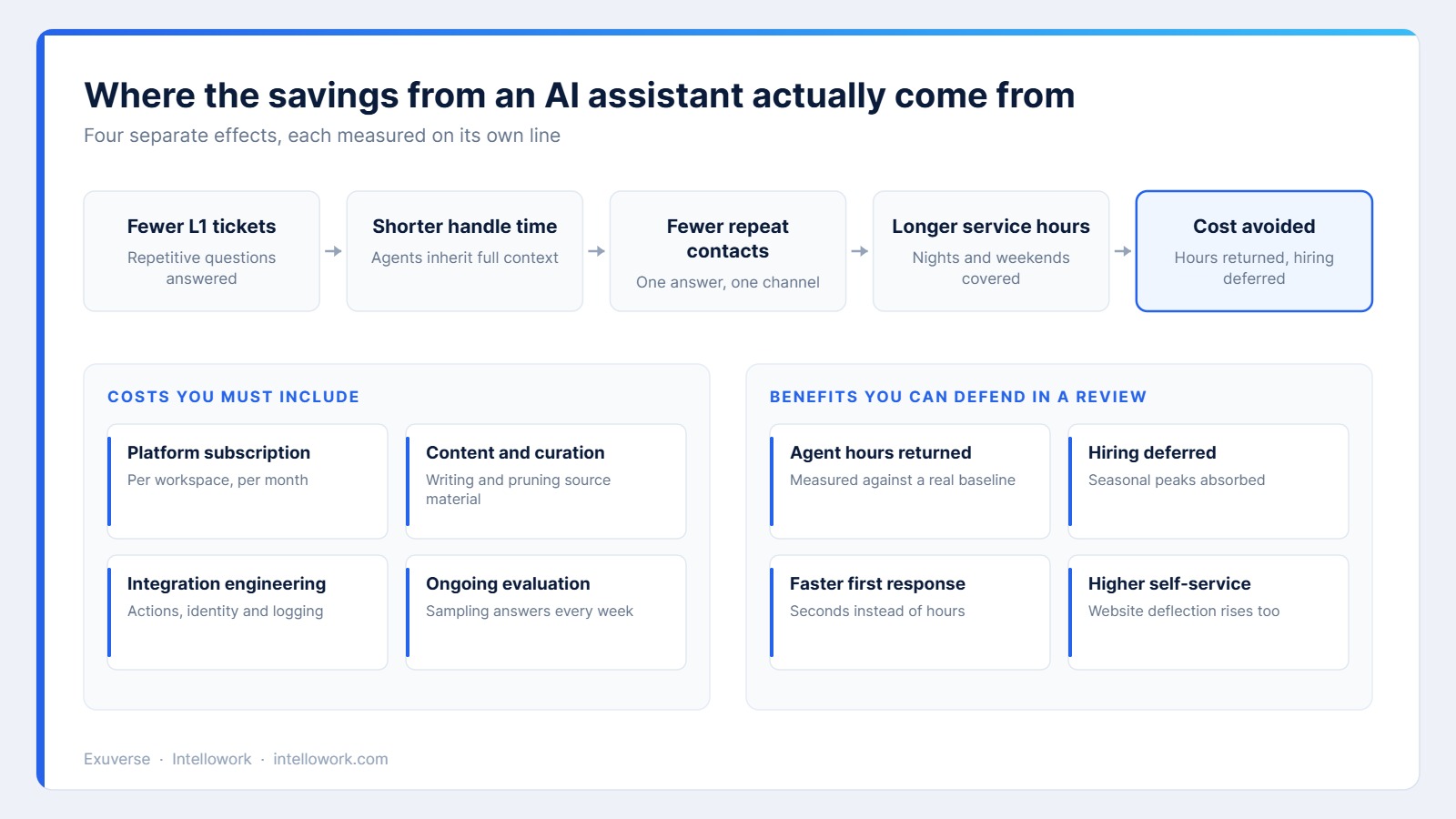
In addition, three lines get missed almost every time. The first is content work, because retrieval only performs as well as the documents behind it. The second is evaluation, since somebody has to read sampled answers every week. The third is integration engineering for actions such as order lookup.
Our breakdown of AI chatbot development cost in India covers those build lines in more depth, and it pairs well with this model.
Why resolution rate is the honest headline metric
Resolution is harder to measure, so teams avoid it. However, three cheap methods work well together. Ask a one-tap confirmation at the end of the conversation. Check whether the same customer contacted you again within seven days. Sample 100 transcripts a week and grade them.
Taken together, those three give you a number you can defend. Better still, sampling surfaces the content gaps that raise the rate next month, which makes it useful rather than merely reassuring.
Benchmarks: what a realistic AI chatbot ROI looks like
| Stage | Resolution rate | What is happening |
|---|---|---|
| Week two of a pilot | 15 to 25 percent | Content gaps dominate |
| Month two | 30 to 40 percent | Top intents covered properly |
| Month six | 45 to 60 percent | Actions connected, abstain rule tuned |
| Mature deployment | 55 to 70 percent | Content maintained as a habit |
Instrumentation you need before you claim anything
You cannot prove a saving without a baseline, so capture three months of ticket data before launch. Record volume by intent, handle time by intent and the cost base for the same period.
After launch, log every conversation with the retrieved passages, the answer, the confidence signal and the outcome. That log is what turns a claim into evidence. Our guide to LLM observability for internal AI assistants explains what to store and why.
Revenue effects, not just cost avoidance
Cost savings are easier to model, yet the revenue side is often larger. Faster answers reduce cart abandonment. Round-the-clock coverage captures buyers in other time zones. Presales questions get answered while intent is still high.
These effects need care, because attribution is messy. Nevertheless, a simple before-and-after comparison on a single funnel step is usually credible enough for a business case. See our note on how chatbots increase sales and conversions for the funnel view.
How grounding changes AI chatbot ROI
An assistant that invents answers has negative return, however good the deflection number looks. Every wrong reply creates a second contact, a complaint or a refund, and each of those costs more than the ticket you avoided.
By contrast, grounded retrieval with visible sources changes the economics. Reviewers can audit an answer in seconds, and customers trust a reply that shows its clause. We covered the mechanism in AI chatbot citations, and the evaluation side in how to evaluate RAG system performance.
A 90-day measurement plan
- Days 1 to 30: capture the baseline, agree the cost per ticket with finance, and pick five intents.
- Days 31 to 60: launch on those intents only, sample 100 transcripts weekly, and fix content gaps.
- Days 61 to 90: connect two read-only actions, measure repeat contact rate, and publish the first honest report.
Above all, agree the definitions with finance in week one. Arguments about arithmetic are much easier before the results arrive.
Common AI chatbot ROI mistakes
- Reporting containment as though it were resolution.
- Using base salary instead of fully loaded cost per ticket.
- Leaving content curation out of the cost side entirely.
- Comparing against a baseline that was never recorded.
- Claiming headcount reduction that the business never intends to make.
Where Intellowork fits
Intellowork grounds every answer in your own documents and shows the source section, so sampling and audit take seconds rather than hours. The same knowledge base serves web, WhatsApp, Slack, Microsoft Teams and voice, which means one content investment improves every channel at once.
Conversation logs include the retrieved passages and the escalation reason, so the measurement plan above is straightforward to run. You can see the platform at Intellowork, and compare approaches with our enterprise chatbot evaluation checklist.
Frequently asked questions
What is a realistic AI chatbot ROI in the first year?
Two to four times the total first-year cost is common when the content already exists. Teams that must write their knowledge base from scratch usually see payback in the second half of the year instead.
Is deflection rate ever useful?
Yes, as a directional signal. It shows channel behaviour changing. Just never present it as a saving, because it counts abandonment alongside success.
How do we agree a cost per ticket with finance?
Take total support cost for a quarter and divide it by resolved tickets in that quarter. Building the figure upward from salary always produces a number that finance rejects.
Should we count reduced headcount?
Only if the business genuinely plans it. Otherwise count deferred hiring, absorbed peaks and extended hours, which are the effects that actually occur.
How long before the numbers stabilise?
Roughly eight to twelve weeks. The first month reflects content gaps rather than capability, so early figures understate what the system will do.
Does channel choice change the economics?
It does. Messaging channels such as WhatsApp carry cheap or free replies inside the service window, while voice costs more per minute. Our guide to the WhatsApp AI chatbot covers that pricing model.
The takeaway
AI chatbot ROI is not hard to prove, but it is easy to overstate. Swap deflection for resolution, use a fully loaded cost per ticket, include content and evaluation on the cost side, and show a sensitivity case. A model built that way tends to survive the second meeting, and it usually still looks good.
Related reading
- Benefits of AI chatbots in customer service
- Build versus buy for an enterprise AI chatbot
- Do chatbots improve customer experience
- AI chatbot for Slack and Teams
Written by the Exuverse team, led by Tarun Gupta, who builds enterprise retrieval and assistant systems for Indian and global teams.