Most teams shopping for a RAG development company in India have already built something themselves. A weekend prototype answered questions about a folder of PDFs, everybody was impressed, and then the same system met the real document estate and fell apart. That gap between demo and production is the actual product you are buying, and it is what separates firms worth hiring from firms that will hand back the prototype you already had.
This guide is written from the delivery side. It sets out what production RAG demands, which roles a serious vendor fields, the questions that expose a weak one, and how these engagements are usually priced. If you want the underlying architecture rather than the hiring decision, our guide to RAG architecture and the deeper piece on retrieval-augmented generation architecture cover that ground properly.
What a RAG development company actually has to deliver
Retrieval-augmented generation sounds like one system. In delivery terms it is at least five, and each fails differently. Ingestion decides what the model can ever see. Indexing decides how it is found. Retrieval decides what reaches the prompt. Generation decides how the answer reads. Observation decides whether anybody can tell when quality drops.
Consequently, a vendor who only talks about prompts and models is describing roughly one fifth of the work. Ask instead about connectors, parsing, chunk boundaries, hybrid search, reranking, evaluation sets and tracing. Those are the parts that consume the schedule.
Above all, a production system has to survive contact with the documents your organisation actually keeps: scanned purchase orders, a 400-page policy manual with nested tables, three versions of the same SOP, and a SharePoint library where half the folders are restricted. None of that appears in a demo.
Why demos succeed and production RAG fails
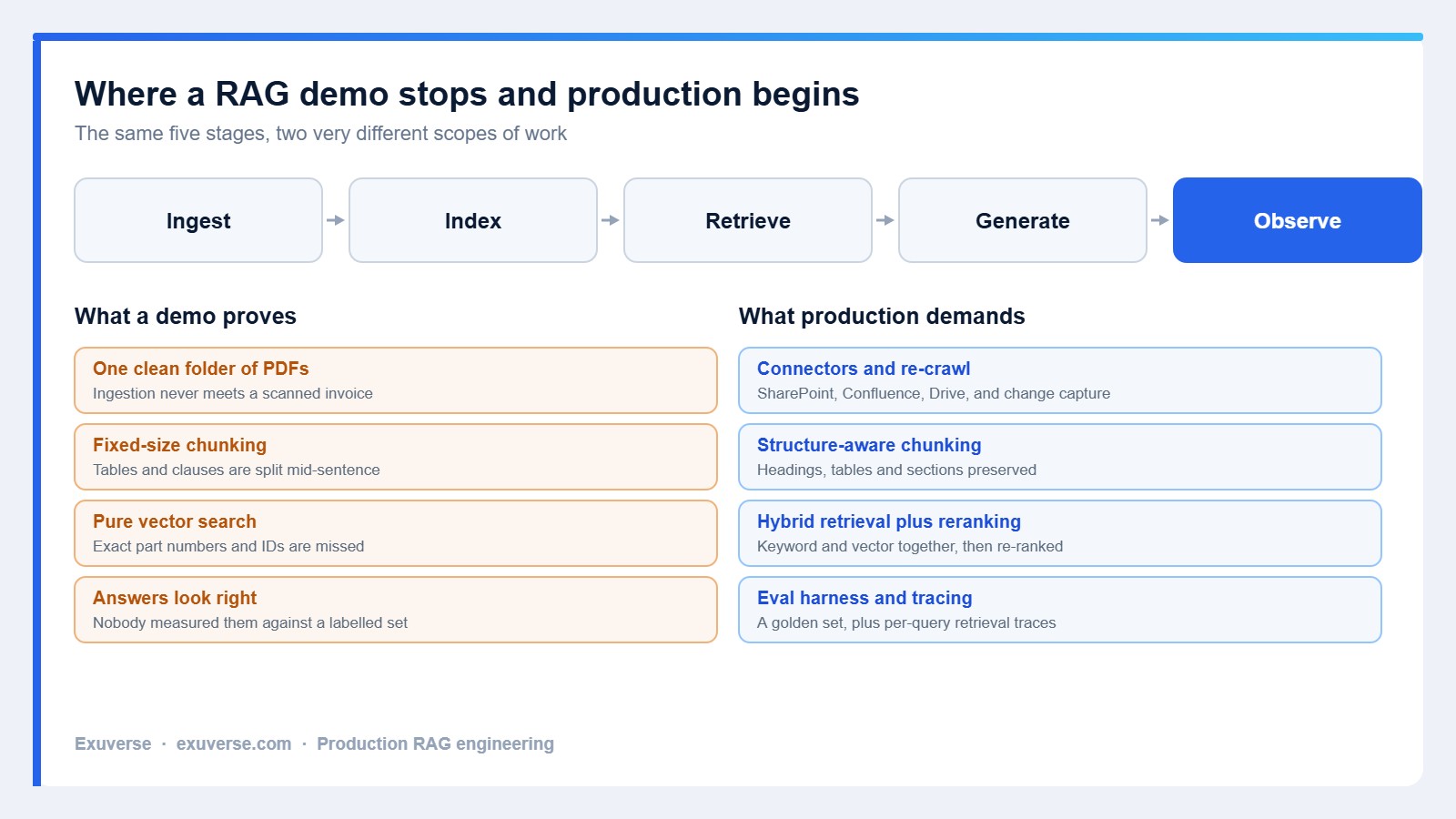
Four failure modes account for most stalled projects, and all four are predictable.
Coverage. The prototype read a clean folder. Production must read scanned documents, spreadsheets, email attachments and a wiki that changes daily. Therefore ingestion needs connectors, parsing that handles messy formats, deduplication and a re-crawl schedule. Managed services help here; Amazon Bedrock Knowledge Bases, for instance, ships connectors for S3, SharePoint, Confluence and Drive alongside smart parsing.
Chunking. Fixed-size chunking splits a table across two chunks and a contractual clause across three. As a result the retriever returns fragments that read plausibly and mean nothing. Structure-aware chunking that respects headings, tables and section boundaries fixes far more accuracy problems than swapping the model does.
Retrieval. Pure vector search misses exact tokens, which is a serious problem when users search for part numbers, policy codes, invoice references or employee IDs. Hybrid retrieval combining keyword and vector, followed by reranking, is the standard answer. We covered the mechanics in hybrid RAG and in hybrid search architecture.
Measurement. Without a labelled evaluation set, quality is an opinion. Every change then becomes a debate, and regressions ship unnoticed. Our guide to evaluating RAG system performance sets out how to build that set, while LLM observability covers the tracing side.
Cost and latency. A prototype answers one question at a time, so nobody notices that each answer makes four model calls. At a thousand queries a day the bill and the tail latency both become visible. Therefore context size, reranking depth and caching need designing early, because retrofitting them later usually means reworking the retrieval layer.
What belongs in the statement of work
Many disputes trace back to a RAG development company proposal that described an outcome without naming the artefacts. Consequently the safest contracts list deliverables explicitly. At minimum, insist on the following.
- A connector inventory naming every source system, its access method and its re-crawl cadence.
- A parsing and chunking specification stating how tables, headings and scanned files are handled.
- The retrieval design, including whether search is hybrid, how reranking works and how results are filtered by permission.
- A golden evaluation set of real questions with verified answers, owned jointly and version controlled.
- Baseline and target metrics for recall, grounding and latency, measured on your corpus rather than a public benchmark.
- Observability: retrieval traces, logged queries and an alerting threshold for quality regression.
- A runbook and handover plan covering reindexing, adding a source and diagnosing a bad answer.
- Ownership terms for the code, the index, the prompts and the evaluation data.
Notably, the last item causes more friction than any technical decision. Settle it in writing before work starts, since renegotiating ownership after a successful build rarely goes well.
Red flags worth walking away from
Some signals reliably predict a difficult engagement with a RAG development company. A proposal that never mentions evaluation is the clearest, because it means quality will be argued rather than measured. Similarly, a fixed price quoted before anyone has seen a sample of your documents suggests the ingestion work has not been considered.
Be equally wary when the pitch centres on a model name. Model choice matters, yet it rarely explains why a system fails; retrieval usually does. Finally, treat reluctance to show an anonymised trace as an answer in itself.
The team a RAG development company must field
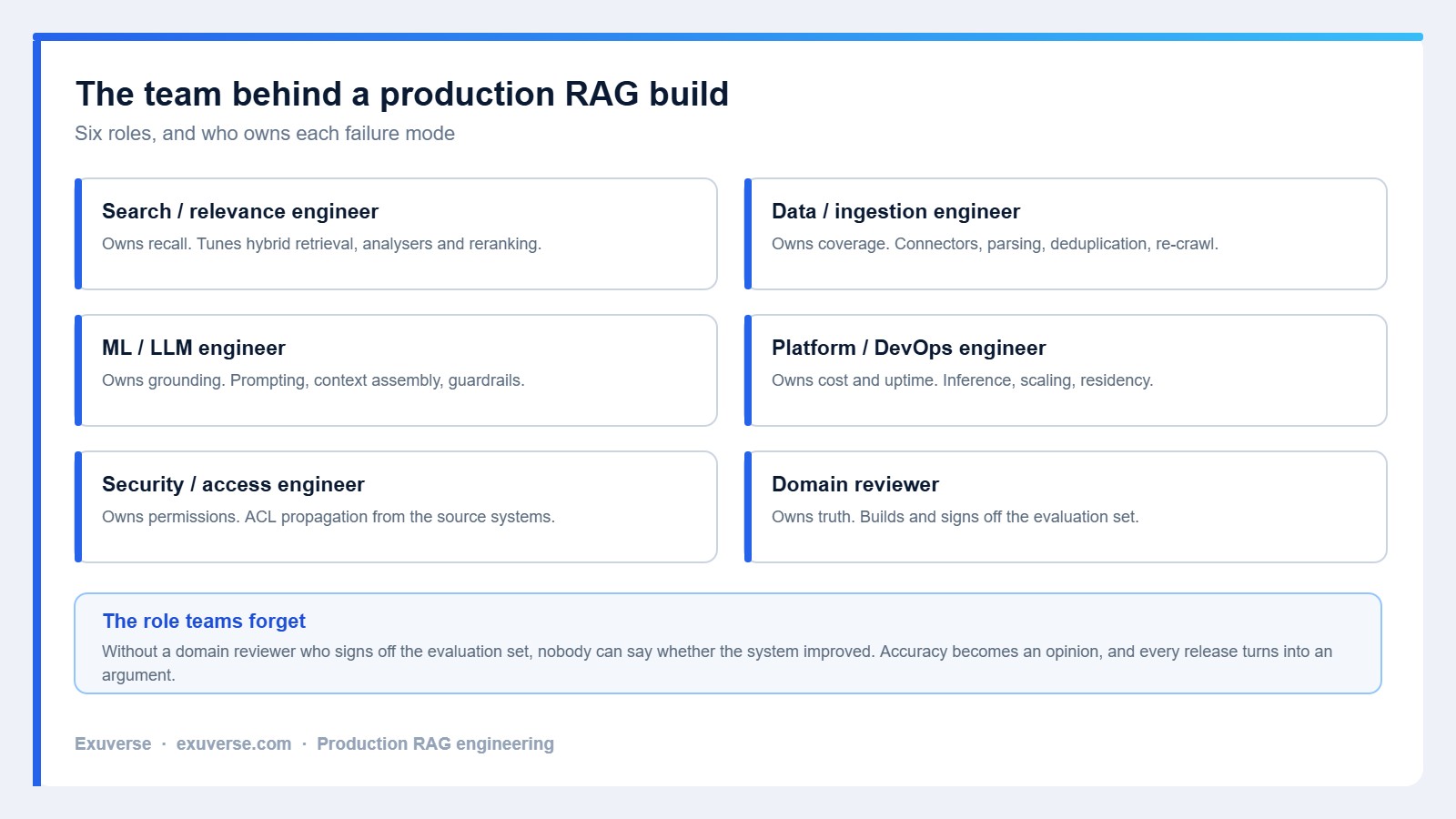
Notice what is missing from most vendor proposals. Teams routinely staff an ML engineer and a backend developer, then discover three months later that nobody owns recall or permissions.
| Role | Owns | What goes wrong without it |
|---|---|---|
| Search or relevance engineer | Recall and ranking | The right document exists but never reaches the prompt |
| Data and ingestion engineer | Coverage and freshness | Answers quote a policy that was superseded last quarter |
| ML or LLM engineer | Grounding and guardrails | Fluent answers with no supporting passage behind them |
| Platform and DevOps engineer | Cost, latency, residency | Inference spend triples quietly, or latency kills adoption |
| Security and access engineer | Permission propagation | A contractor retrieves a document they cannot open directly |
| Domain reviewer from your side | The evaluation set | Nobody can prove the system improved |
That last row deserves emphasis, because it is the one you supply rather than buy. A vendor who does not ask for a domain reviewer has not planned to measure anything.
Nine questions that separate a real RAG development company from a reseller
Ask these in the first technical call. Vague answers here reliably predict trouble later.
- How will you chunk a 300-page manual with nested tables? Listen for structure-aware strategies, not a token count.
- Is retrieval hybrid, and how is reranking applied? Pure vector search alone signals inexperience with enterprise corpora.
- How do source permissions reach the retriever? The answer must involve ACLs at retrieval time, not a filter applied after generation.
- What does your evaluation set look like? Expect a golden set of real questions with verified answers, plus per-query retrieval traces.
- How will we know when quality drops? Look for tracing, logged retrievals and regression runs on every release.
- Where does inference run, and in which region? This matters for latency, cost and procurement. Our note on secure RAG for private data covers the governance angle.
- What happens when the system does not know? Abstention and handoff should be designed, not accidental.
- How do documents stay current? Re-crawl cadence, change capture and deletion handling all need answers.
- Who owns the code and the index at the end? Settle this before the contract, not after.
Additionally, ask to see a retrieval trace from a real project with the client details removed. Firms that have shipped production systems have these readily. Firms that have not will offer a slide instead.
Engagement models and how the cost is structured
Three shapes are common in the Indian market, and each suits a different level of certainty about scope.
| Model | Best when | Main risk |
|---|---|---|
| Fixed-scope pilot | You need proof on one corpus before committing | Scope creep once real documents arrive |
| Dedicated team | Scope will evolve and integrations are numerous | Drift without a measurable definition of done |
| Build and transfer | You intend to run it in-house afterwards | Knowledge transfer treated as an afterthought |
Rather than quote day rates here, which vary widely by seniority and city, we keep that discussion in our software development cost and engagement guide. What matters more is the shape of the estimate. A credible proposal prices ingestion and evaluation as substantial line items. A weak one prices the chatbot interface and treats data work as a rounding error.
Watch the inference bill too. Retrieval volume, context size and reranking calls drive ongoing cost, so ask for a projected monthly figure at your expected query volume, not just a build price.
How we measure success on a RAG build
Since claimed accuracy figures are unverifiable across different corpora, treat the following as the evaluation framework we apply rather than as published benchmarks. Your numbers will depend on your own documents.
| Measure | How it is tested |
|---|---|
| Retrieval recall | For each golden question, does the correct passage appear in the retrieved set |
| Grounding rate | Share of answers fully supported by a cited passage, judged by a domain reviewer |
| Abstention quality | How often the system declines correctly, versus answering anyway |
| Permission correctness | Restricted questions asked from a low-privilege account must return nothing |
| Freshness lag | Time between a source document changing and the index reflecting it |
| Latency and unit cost | Median and tail response time, plus cost per answered query at real volume |
Insist that these run automatically on every release. Otherwise regressions arrive silently, which is how trust in an internal assistant collapses within a quarter.
Building in-house versus hiring a RAG development company
Both routes work, and whether you need a RAG development company at all depends on how central retrieval quality is to your business.
| Criterion | In-house team | External RAG partner |
|---|---|---|
| Time to first production system | Longer, with hiring on the critical path | Shorter, since the patterns already exist |
| Domain knowledge | Strong from day one | Needs deliberate transfer |
| Relevance engineering depth | Rare and hard to hire | Usually the reason to engage one |
| Long-run cost | Lower once the team is productive | Higher per month, lower upfront risk |
| Best fit | Retrieval is a core product capability | Retrieval supports the business, rather than being it |
We have argued the general version of this elsewhere, in build versus buy for enterprise AI chatbots. A hybrid arrangement is often sensible: an external team builds and instruments the first system, while your engineers take ownership alongside them.
A worked example: three million documents and a permissions problem
A manufacturing group approached us with a corpus of roughly three million documents spread across a file server, Confluence and an older document system. Their internal prototype answered general policy questions well. However, it failed on two things that mattered: part-number lookups, and anything where access depended on plant location.
The part-number failure was a retrieval problem rather than a model problem. Pure vector search treated alphanumeric codes as noise, so adding a keyword leg and a reranking stage resolved most of it. Meanwhile the permissions issue required propagating source access controls into the index, so that retrieval itself was filtered rather than the output.
Neither fix involved a larger model. Instead both sat in the retrieval layer, which is consistently where the returns are. Our piece on RAG performance optimization goes through these trade-offs in detail, and RAG for internal knowledge bases covers the wider pattern.
Pros and cons of working with Exuverse
Where we are a strong fit. Search relevance is our background rather than an add-on, which shows in hybrid retrieval and ranking work. We build on AWS with the Mumbai region as the default, which simplifies residency conversations for Indian buyers. We instrument evaluation and tracing from the first sprint, so quality is measurable rather than asserted. Furthermore, we have shipped both the platform product and bespoke builds, so the build-versus-buy advice is grounded in doing both.
Where we are not. We are an engineering team, not a staffing desk, so very short augmentation engagements are a poor fit. We also insist on a domain reviewer from your side, which some teams find inconvenient, though projects without one tend to drift. If your requirement is a simple website chatbot over twenty pages of content, a product such as Intellowork will serve you faster and more cheaply than a custom build. Saying so costs us work occasionally, yet it saves everyone a wasted quarter.
Frequently asked questions
What should a RAG development company in India cost?
Costs vary by team seniority, corpus complexity and integration count, so any single figure quoted without seeing your documents is guesswork. Judge the estimate by its shape instead. Ingestion, evaluation and permissions should be substantial line items, and the proposal should include a projected monthly inference cost at your expected query volume.
How do I verify a RAG development company has done this before?
Ask for an anonymised retrieval trace and an evaluation report from a delivered project. Teams that have run production systems produce these quickly. Additionally, ask which retrieval failures they hit and how they diagnosed them, since the specifics are difficult to fabricate.
How long does a production RAG build take?
A focused pilot on one corpus typically runs six to ten weeks. Full production, including connectors, permissions, evaluation and monitoring, more often takes four to six months. Integration count drives the schedule far more than model choice does.
Do we need our own vector database?
Not necessarily. Managed options reduce operational burden considerably, whereas self-hosted stores make sense when you already run the infrastructure or have strict residency constraints. The decision should follow your platform strategy rather than lead it.
Can we start with a pilot instead of a full build?
Yes, and we usually recommend it. Choose one corpus and one user group, build the evaluation set first, then measure. Because the pilot surfaces ingestion and permission problems early, it de-risks the larger programme considerably.
What happens after launch?
Documents change, users ask new questions, and retrieval quality drifts. Plan for ongoing relevance tuning, scheduled regression runs against the golden set, and periodic review of abstention behaviour. Treat the system as a product rather than a project.
Work with us
If your prototype has stalled on messy documents, missing permissions or answers nobody can verify, those are retrieval and data problems with known solutions. Exuverse builds production RAG systems on AWS with search relevance engineering at the centre, and we instrument evaluation from the start so quality stays measurable.
You can read more about our AI and generative platforms and search relevance engineering work, or talk to our team about a scoped pilot. Bring your hardest hundred questions and the corpus that broke the prototype.