
Apache Solr is free to download and expensive to get wrong. Most teams that search for Apache Solr consulting services are not looking for someone to install it. They already have a cluster. What they have is a relevance problem, a latency problem, an upgrade they keep postponing, or a cost line that has quietly become the largest item in the platform budget. This article explains when a Solr specialist earns their fee, what the work actually involves, and what it costs in India and abroad, so you can decide whether to bring one in or keep going in-house.
What Apache Solr consulting services actually cover
Solr is a mature search platform built on Apache Lucene, and it runs some of the largest indexes in the world. However, its maturity is also the problem. There are two decades of configuration options, several distinct deployment modes, and a schema language that rewards people who have already made the mistakes. Consequently, Apache Solr consulting services tend to fall into six recognisable shapes.
| Engagement type | Typical trigger | What the consultant delivers | Usual duration |
|---|---|---|---|
| Relevance tuning | Users complain that search “doesn’t find things” | Judgment set, then analyzer and boosting changes, re-ranking and a measured NDCG lift | 3 to 8 weeks |
| Performance and scale | p95 latency climbs, indexing falls behind, or nodes run out of heap | Sharding plan as well as cache and GC tuning, hardware right-sizing and a load test report | 2 to 6 weeks |
| Upgrade and migration | Stuck on Solr 6, 7 or 8, or Java or Jetty end of life, or security findings | Compatibility audit first, then schema and config migration, then a blue-green cutover | 4 to 12 weeks |
| SolrCloud architecture | Standalone Solr can no longer meet uptime targets | Collection design and replica types, as well as ZooKeeper, backup and recovery runbooks | 3 to 8 weeks |
| Vector and hybrid search | Product team wants either semantic search or RAG on top of Solr | Dense vector fields and an embedding pipeline, as well as hybrid ranking and an evaluation harness | 4 to 10 weeks |
| Managed operations | No one in-house wants to be on call for search | Monitoring and patching, as well as capacity reviews and incident response under an SLA | Ongoing, monthly |
The Solr projects behind this advice
Exuverse has delivered all six, from a 50,000-employee enterprise search migration off Solr onto Azure AI Search, to a diagnostic-code index of more than 50 million records, to distributed Solr clusters indexing more than 50 billion web pages. Furthermore, those projects are described on our search platform projects page, and they shape the advice below.
When to bring in a Solr expert
The honest answer is: later than most vendors say, and earlier than most engineering managers admit. Here are the signals that consistently mark the point where Apache Solr consulting services pay for themselves.
Relevance has become a matter of opinion
If your team argues about whether search got better after a change, you have no evaluation set. A Solr specialist’s first job is usually to build one from your query logs, so that relevance becomes a number. Without that, every boost and synonym is a guess, and guesses accumulate into a config nobody dares touch.
You are more than two major versions behind
Solr 10.0.0 shipped on 3 March 2026. It requires Java 21, moves to Jetty 12 and Lucene 10, replaces OpenTracing with OpenTelemetry, and removes several long-deprecated field types and the built-in Tika extraction. Each of those is a breaking change for someone. Teams still on Solr 7 or 8 face two hops, and each hop has its own set of removed features. This is the single most common reason enterprises call us.
Latency is fine until it is not
Solr performance problems rarely announce themselves. A collection grows, a facet query gets one more field, and one day the p95 crosses a second. Furthermore, the fix is seldom “add nodes”. It is usually a mix of document routing, replica type selection, cache sizing, and stopping the query that pulls 10,000 rows for a UI that shows ten.
The business wants AI on top of search
Retrieval-augmented generation lives or dies on retrieval quality. Solr 9 added dense vector fields, and Solr 10 adds scalar and binary quantised vectors plus optional GPU acceleration through cuVS. However, wiring an embedding pipeline into an existing lexical index, and then ranking the two together, is where most in-house attempts stall. We covered the architecture in our post on RAG with Solr and Elasticsearch and the ranking side in hybrid keyword and vector search.
Nobody owns it
Search is often inherited, unfortunately. The engineer who set it up has left, the config is undocumented, and the cluster is treated as infrastructure that must never be restarted. That is the moment to bring in someone who can document, stabilise and hand back a system the current team can run.
How a Solr consulting engagement actually works
Good Apache Solr consulting services run as a measured loop, not a set of opinions. Below is the workflow we use, which maps to the way Solr itself processes a query.
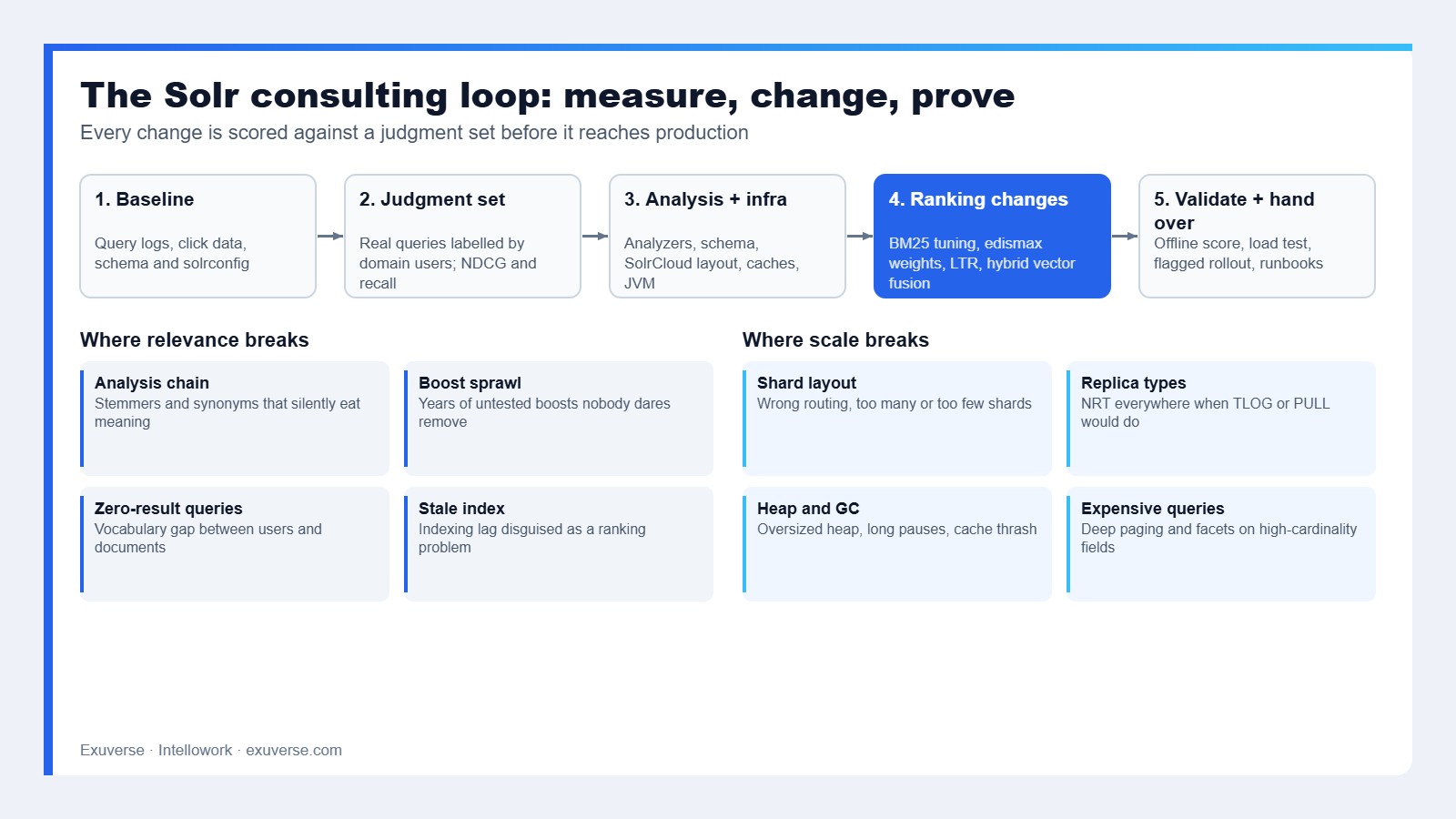
Input: query logs and a judgment set
We start with the raw material: the last 30 to 90 days of query logs, click data if it exists, and the current schema and solrconfig. From the logs, we pick a few hundred representative queries and have domain users label which results are good. From then on, that judgment set is the contract for the rest of the project.
Processing: analysis chain and schema review
Most relevance problems live in the analysis chain. Tokenisers, stemmers, synonym filters and stopword lists decide what a document “contains” before any ranking happens. As a result, we review each field type against real queries, fix the analyzers that are silently eating meaning, and only then look at boosting and function queries.
Technology: SolrCloud, replicas and caches
On the infrastructure side, we look at collection layout, shard count, replica types (NRT, TLOG or PULL), ZooKeeper health, JVM heap and garbage collection, and the filter, query and document caches. The aim, in short, is a cluster whose behaviour under load is predictable, which is usually a smaller cluster than the one we found.
Decision layer: ranking and re-ranking
With clean analysis and stable infrastructure, ranking work becomes productive. This can mean tuned BM25 parameters, edismax field weights, function-query freshness and popularity signals, or a learning-to-rank model trained on click data. Solr 10 also improves the LTR module, which we discussed in our earlier piece on learning to rank for search.
Output and monitoring
We score every change offline against the judgment set, then load-test it, and then ship it behind a flag. We hand over dashboards for latency, cache hit rates, indexing lag and relevance metrics, plus a runbook the in-house team can follow at 2 a.m.
A practical example
An automotive diagnostics platform we built indexes more than 50 million vehicle trouble codes on Apache Solr, and technicians search it with symptom descriptions rather than code numbers. Exact-match search handles code lookups well, but natural-language symptoms badly. The design therefore added an NLP layer using spaCy and NLTK for entity extraction and preprocessing, so that a query such as “engine misfire on cold start” is mapped to the entities the index actually contains, with real-time suggestions and diagnostic decision trees on top. In short, that is the general pattern: fix what the index understands before tuning how it ranks, and measure each change against real technician queries rather than a demo set.
What Apache Solr consulting services cost
Solr has no licence fee, so the cost of Apache Solr consulting services is entirely people and infrastructure. Published rates vary widely by geography and firm size, and the ranges below come from public market data rather than from Exuverse pricing. Treat them as orientation, not a quote.
| Source of expertise | Reported rate | Notes |
|---|---|---|
| Offshore or outsourced consultants | USD 25 to 75 per hour | Wide quality spread, so verify Solr-specific experience rather than generic Java |
| Independent freelancers | USD 100 to 300 per hour | Strong for tuning sprints, but weaker for on-call operations |
| Small specialist firms | USD 75 to 175 per hour | Usually the best fit, especially for mid-market projects |
| Large consultancies | USD 200 to 300 per hour | Adds programme management overhead as well |
| UK contract market (median day rate) | About GBP 675 per day | Six months to September 2026, per ITJobsWatch |
| Managed Solr hosting | USD 59 to about 3,000 per month | Removes operations, but not relevance work |
Apache Solr consulting services pricing in India
In India, meanwhile, specialist search engineering firms typically price fixed-scope engagements rather than hourly, because clients want a number before they start. A relevance tuning sprint or a performance review usually lands in the low lakhs, an upgrade or SolrCloud migration in the mid to high lakhs depending on collection count and cutover complexity, and managed operations as a monthly retainer sized to cluster count and SLA. Above all, the variables that move the price most are the number of collections, whether there is an existing judgment set, the version gap, and whether the cutover has to be zero-downtime.
However, one cost is often missed. The most expensive Solr project is the one done by a capable generalist team without search experience, because it ships, works for a year, and then has to be redone when the index triples. The same dynamic applies to LLM infrastructure, and for the same reason: the cheap decision is made before the load arrives.
Apache Solr consulting services versus in-house versus managed hosting
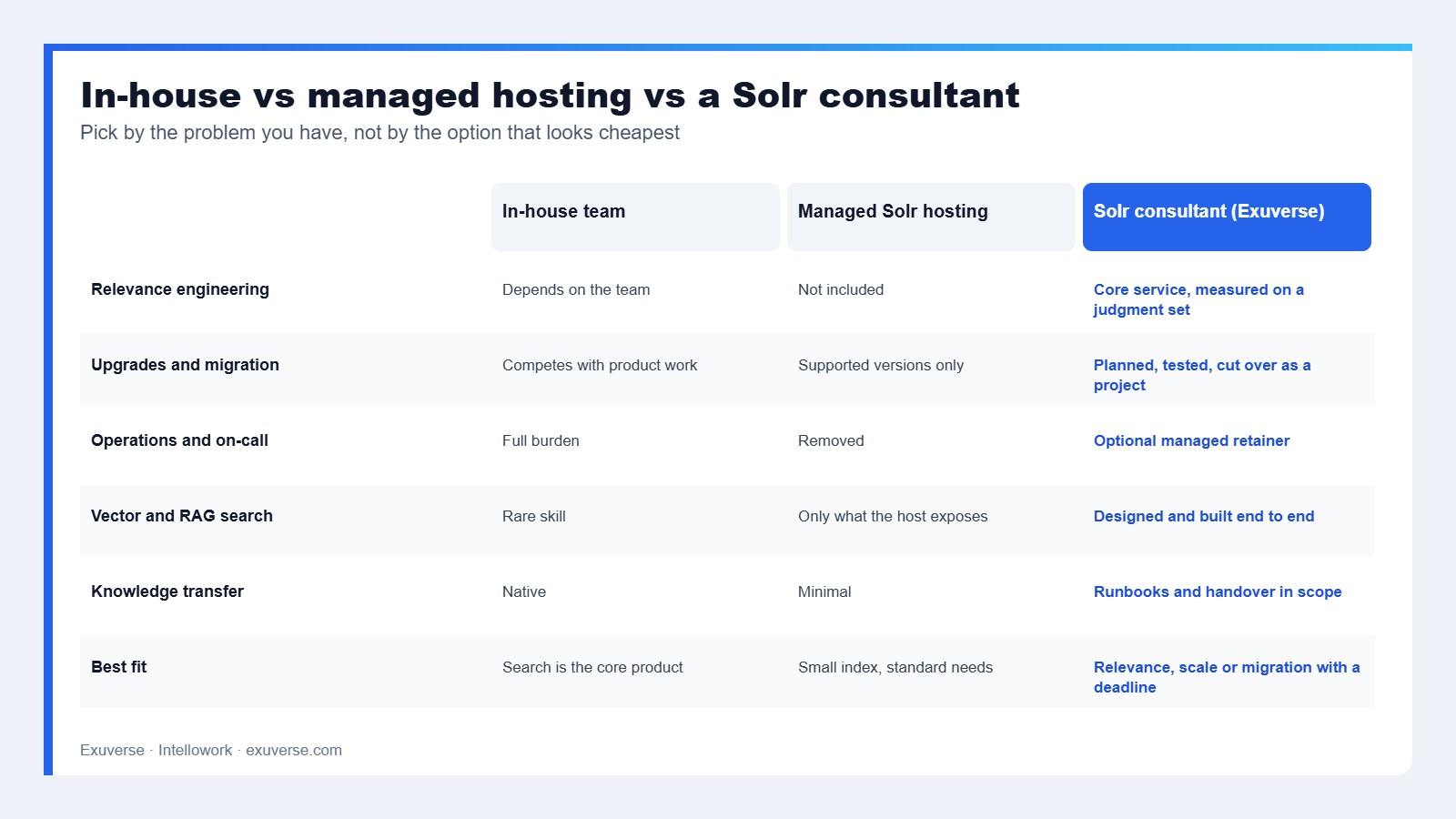
In-house teams, managed hosting and Apache Solr consulting services are not rivals so much as tools for different stages. Therefore, the comparison below reflects how we see the trade-offs after years of doing all three for clients.
| Criterion | In-house team | Managed Solr hosting | Exuverse Solr consulting |
|---|---|---|---|
| Relevance engineering | Depends entirely on who is on the team | Not included | Core service, and measured against a judgment set |
| Upgrades and migrations | Slow, because it competes with product work | Handled, but only for supported versions | Planned and tested, then cut over as a project |
| Operations and on-call | Full burden | Removed | Optional, as a managed retainer |
| Vector and RAG integration | Rare in-house skill | Limited to what the host exposes | Designed and built, including the embedding pipeline as well |
| Knowledge transfer | Native | Minimal | Documented handover as well as runbooks are part of scope |
| Data residency | Full control | Depends on regions offered | Runs in either your cloud or your data centre |
| Cost pattern | Salaries, ongoing | Monthly, so it scales with cluster size | Either a fixed-scope project or a monthly retainer |
| Best fit | Search is a core product with a dedicated team | Small index, standard needs, and no relevance work | Relevance, scale, migration or AI work, especially with a deadline |
Which option fits which team
For example, if your index is small and your relevance needs are ordinary, managed hosting is probably enough. If search is your product, then build the team. The middle case, which is most enterprises, is where a specialist engagement makes the difference between a search box and a search system.
Pros and cons of hiring Apache Solr consulting services
The advantages of Apache Solr consulting services are practical. A specialist has already seen the failure mode you are in, so diagnosis is fast. Work is scoped and measured, so you know what you paid for. Knowledge transfer is explicit as well, which means you are not renting a dependency. Additionally, a firm that also builds RAG and enterprise search products, as we do with Intellowork, can take Solr from keyword retrieval to grounded AI answers without a second vendor.
The limitations, however, are just as real. A consultant cannot fix a content problem; if your documents are poorly structured, no analyzer will rescue them. A short engagement can leave the in-house team unable to maintain what was built, unless you plan the handover from day one. Furthermore, consulting is not the right model for a team that needs a permanent search engineer. In that case, hire, and then use a consultant to accelerate the first six months.
How we measure Apache Solr consulting services
We do not publish client performance figures beyond the project summaries on our portfolio page, so this is the evaluation framework we agree with every client before Apache Solr consulting services begin.
| Measure | How it is captured | Why it matters |
|---|---|---|
| NDCG at 10 and recall at 20 on the judgment set | Offline evaluation harness, run after every change | Relevance becomes a number, so the team can improve against it |
| p95 and p99 query latency under production load | Load test before and after, as well as live dashboards | Users notice tail latency rather than averages |
| Indexing lag and commit throughput | Cluster metrics | Stale results are, in effect, a relevance failure in disguise |
| Zero-result and low-click query rate | Query log analysis | Shows exactly where users give up |
| Cluster cost per million queries | Cloud billing against traffic | Right-sizing usually cuts spend as well as latency |
| Runbook completeness and handover sign-off | Checklist signed by the in-house team | Proves the client can then operate without us |
Frequently asked questions
What does a Solr consultant do?
A Solr consultant diagnoses and fixes search relevance, performance, architecture and upgrade problems in Apache Solr deployments. Typical work includes building an evaluation set, tuning analyzers and ranking, designing SolrCloud collections, migrating between major versions, and adding vector or hybrid search for AI use cases.
How much do Apache Solr consulting services cost?
Public market data puts hourly rates for Apache Solr consulting services between USD 25 and 300 depending on geography and firm type, with UK contractors at a median of about GBP 675 per day in 2026. Indian specialist firms usually quote fixed-scope projects instead, with tuning sprints in the low lakhs and migrations higher. Managed hosting runs from about USD 59 to 3,000 per month but does not include relevance work.
Should we upgrade to Solr 10?
If you are on Solr 9.x with Java 21 available, then the upgrade is worth planning for the vector search and observability improvements. If you are on Solr 8 or earlier, plan two hops, audit the removed field types and the Tika extraction dependency, and treat it as a migration project rather than a version bump.
Is Solr still relevant compared to Elasticsearch or OpenSearch?
Yes. Solr remains a fully open-source Apache project with active releases, strong faceting, mature SolrCloud clustering and, since version 9, dense vector search. Ultimately, the right choice depends on your team’s skills, licensing preferences and the rest of your stack, which is why we work with all three engines rather than advocating one.
Can Solr be used for RAG and AI search?
Yes. Solr supports dense vector fields and k-nearest-neighbour queries, and Solr 10 adds quantised vectors and optional GPU acceleration. For instance, a typical design keeps lexical BM25 retrieval for precision, adds vector retrieval for recall, and fuses the two before passing passages to a language model. Intellowork uses exactly this pattern.
How long do Apache Solr consulting services engagements take?
Apache Solr consulting services for relevance and performance usually run three to eight weeks. Upgrades and SolrCloud migrations run four to twelve weeks depending on collection count and cutover constraints. Managed operations continue monthly for as long as you need them.
Do you work with Solr deployments hosted in India?
Yes. Exuverse is based in Noida and works with Solr running on-premises, in Indian cloud regions and in global clouds. Data stays in your environment, because we work inside it rather than moving your index elsewhere.
Talk to us about your Solr cluster
If your search is slow, your relevance is argued about rather than measured, or your upgrade has been postponed twice, that is the problem Apache Solr consulting services solve. Exuverse’s search and relevance engineering team will baseline your current cluster against real queries and show you what a measured improvement would look like before you commit to anything. Book a free search consultation, or read our company profile for the projects behind this advice.