
Choosing a software development company in Noida is mostly a risk decision, not a price decision. The city has hundreds of firms, and their day rates look similar on a proposal. What differs is who actually writes the code, how the team handles change, and whether anyone owns the outcome after go-live. This guide breaks down 2026 price bands, the four engagement models buyers are offered, and a checklist you can run in a single call. We built it from the questions our own clients ask before they sign, so it is deliberately practical. Read it, borrow the checklist, and use it on every vendor you shortlist — including us.
The short answer
A good software development company in Noida costs $20–$90 an hour depending on seniority, works in a dedicated-team model after a short paid discovery, gives you repository ownership from the first commit, and names the engineers who will actually build your product. Everything below explains how to verify each of those four points before you sign, and what to do in the first month once you have.
What a software development company in Noida actually delivers
In practice, the label covers a wide range. At one end sit staffing firms that place developers on your payroll and step away. At the other end sit product engineering partners who run discovery, architecture, delivery, QA and support as one loop. Both are legitimate. However, they solve different problems, so mixing them up is the most common and most expensive mistake buyers make.
Here is the useful way to think about it. Ask what you are buying: hours, or a working system. If you already have a technical lead, a backlog and a definition of done, you are buying hours, and a staffing model works well. If you have a business problem and a deadline, you are buying an outcome, and you need a partner who will push back on scope.
Most mid-sized Indian and overseas buyers sit somewhere in the middle. They have a rough idea, some internal stakeholders, and no spare engineering capacity. For them the right answer is usually a small senior team with a named architect, plus a short paid discovery before anything gets estimated.
Why Noida turned into a serious engineering base
Noida is not a cheaper Bengaluru. Instead, it grew differently. Sector 62, Sector 63, Sector 125, Sector 132 and Sector 140A now hold a dense mix of global capability centres, product startups and services firms, and the talent moves between them constantly. That density matters, because it is what lets a small firm hire a senior React or data engineer inside six weeks rather than six months.
Meanwhile, the policy side has also moved. Uttar Pradesh has publicly targeted roughly a tenth of every new global capability centre set up in India, and it is backing that with data centre capacity, deep tech hubs and skilling programmes. As a result, the supply of engineers who have worked to international standards keeps rising in the region.
For a buyer, three practical consequences follow. First, senior talent is available without a Bengaluru premium. Second, the airport, the expressway and the metro make on-site visits easy from Delhi. Third, most Noida firms already work across US and European time zones, so overlap is a solved problem rather than a negotiation.
| Noida cluster | What it is known for | Typical fit |
|---|---|---|
| Sector 62 / 63 | Mature IT services, BPO, mid-size product firms | Maintenance, support desks, large delivery teams |
| Sector 125 / 126 | Corporate campuses, finance and consulting back offices | Regulated workloads, enterprise integrations |
| Sector 132 / 135 | Infrastructure, cyber security and managed services | Network, security operations, AMC |
| Sector 140A / Expressway | Newer product and AI engineering studios | Custom builds, AI features, greenfield products |
Software development company in Noida: 2026 price bands
Rates in India cluster tightly, so a quote far outside these bands deserves a question. Independent 2026 rate surveys put Indian engineering roughly where the table below sits, and AI engineering carries a clear premium because the talent pool is still thin.
| Role | Hourly (USD) | Monthly dedicated (USD) | What you should expect |
|---|---|---|---|
| Junior engineer (1–3 yrs) | $20–$30 | $3,000–$4,500 | Supervised work, needs review time |
| Mid-level engineer (3–5 yrs) | $35–$50 | $5,000–$7,000 | Owns features end to end |
| Senior full-stack (6–10 yrs) | $45–$65 | $6,500–$9,500 | Owns a service, mentors juniors |
| Principal / tech lead | $65–$90 | $9,500–$13,000 | Architecture, trade-offs, hiring |
| AI / ML engineer | $55–$85 | $8,000–$12,000 | Retrieval, evaluation, guardrails |
Compare that with $50–$300 an hour in the United States and $50–$199 across Western Europe, and the arbitrage is obvious. Yet the arbitrage is also where buyers get burned. A $20 rate with three rounds of rework costs more than a $55 rate that ships once. Therefore, judge the blended cost of a delivered feature, not the sticker rate of a seat.
In addition, one more caution on cost is worth adding. Quotes that exclude QA, DevOps and project management look cheap and then grow by a third. Ask every vendor to show the blended monthly cost of the whole pod, including the people who are not writing feature code.
The four engagement models, compared honestly
In general, every proposal you receive will be one of these four. Each one moves risk to a different side of the table, so pick the model that matches how well you actually understand the scope.
| Model | Who carries the risk | Works when | Fails when |
|---|---|---|---|
| Fixed price | The vendor | Scope is written down and frozen | Requirements move; change orders pile up |
| Time and materials | You | Discovery, R&D, unclear scope | Nobody tracks burn against value |
| Dedicated team | Shared | Long roadmap, product ownership in-house | You have no one to prioritise the backlog |
| Outcome or milestone | Shared, milestone by milestone | Clear business metric to hit | The metric is vague or unmeasurable |
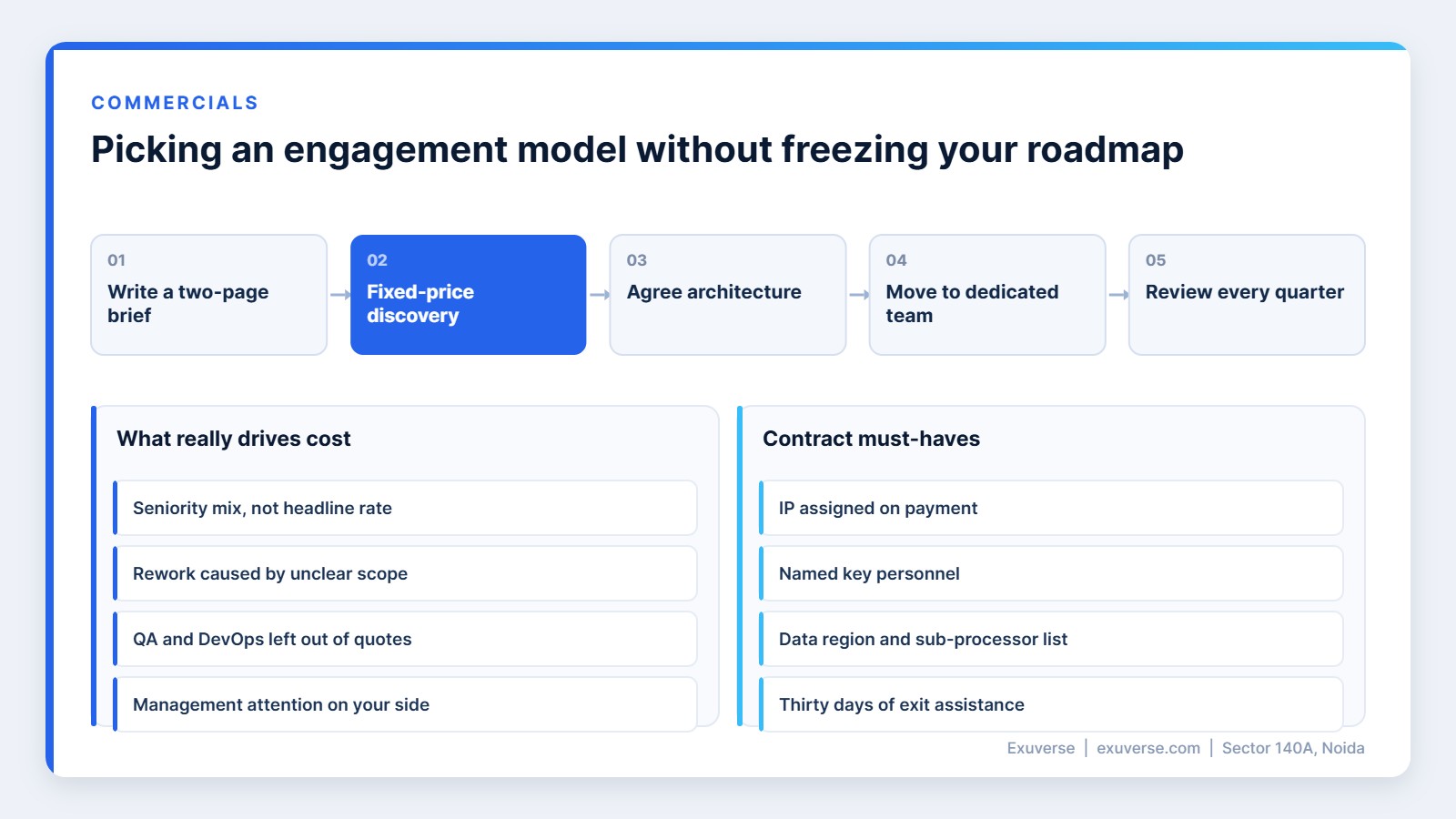
In practice, a hybrid works best. Start with a short fixed-price discovery of two to three weeks. Then move to a dedicated team once the architecture and the first slice of scope are agreed. That way you cap the cost of being wrong early, and you keep flexibility later.
How to choose a software development company in Noida: a 10-point check
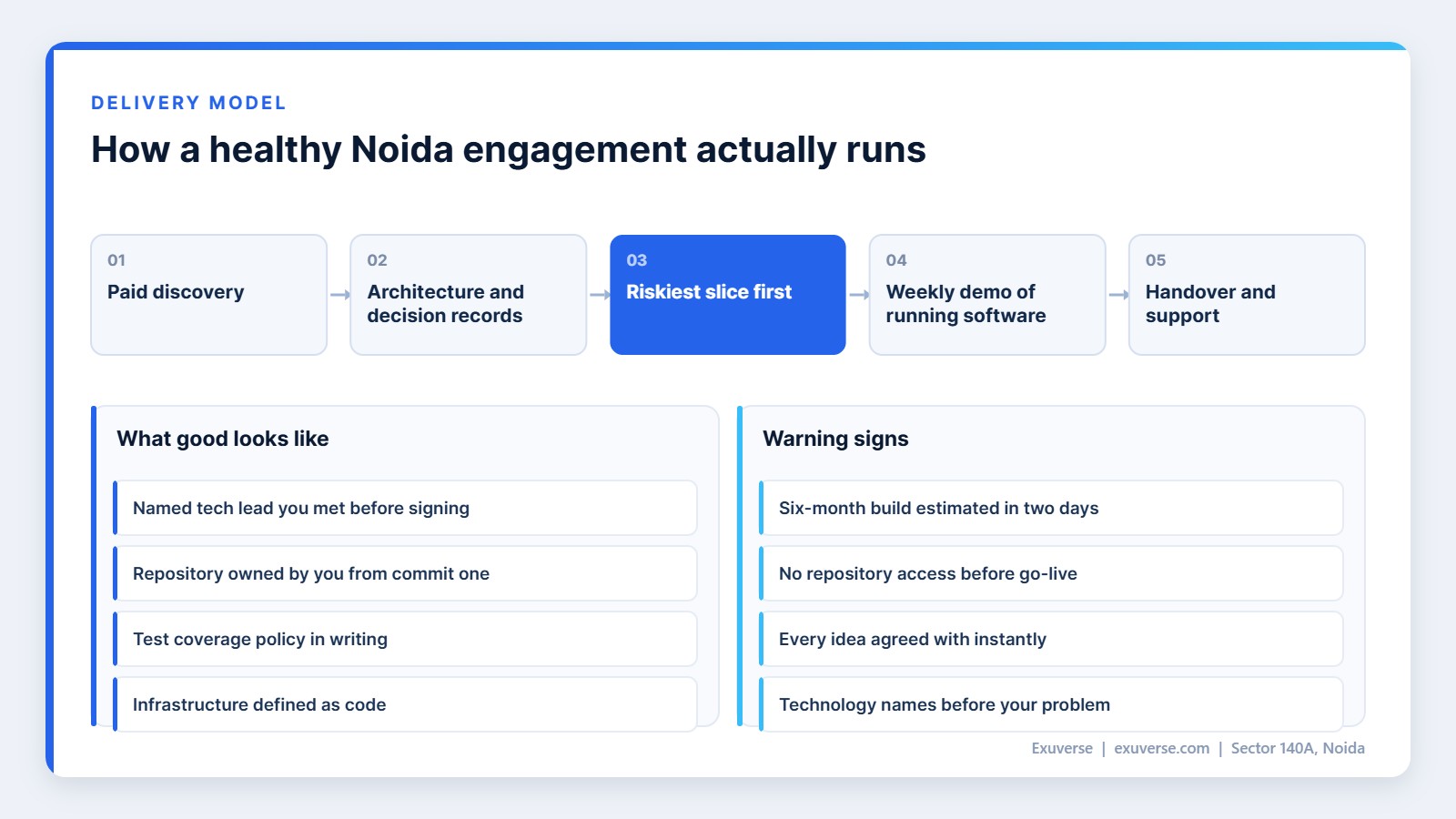
First, run this list in one call. Any good partner answers all ten without preparation, and the weak ones stall on questions four, seven and nine.
- Who exactly writes the code? Ask for names, years of experience and current allocation. Sales engineers who vanish after signing are the oldest trick in the business.
- Can I meet the tech lead before signing? If the answer is no, the answer is no.
- Show me a repository you own. Commit history, branch hygiene and pull request comments reveal more than any case study.
- What is your test coverage policy? A firm that cannot answer this ships bugs to your users.
- How do you handle scope change? Look for a written change process, not goodwill.
- What does handover look like? Code, infrastructure as code, credentials, runbooks and a walkthrough, all yours.
- Where does my data live? Region matters under India’s DPDP Act and under GDPR, so get the hosting region in writing.
- Who is on call after launch? Support terms belong in the contract, not in an email.
- What went wrong on your last project? Honest teams have a real answer ready.
- Can I talk to a client who left you? Rare, brave, and extremely revealing.
Red flags that predict a bad build
Some warning signs show up long before the contract, and every software development company in Noida you meet should survive this filter. Watch for a proposal that estimates a six-month build in two days, because that means nobody read the requirements. Similarly, be wary of a team that agrees with every idea you float, since a partner who never disagrees is not thinking. Finally, treat a refusal to give you repository access from day one as a warning, because it usually hides subcontracting.
Finally, be careful with firms that lead with technology names instead of your problem. If the first slide says microservices and the second says blockchain, but nobody has asked what your users struggle with, keep looking.
What a good discovery phase looks like
In fact, discovery is where most of the money is saved. A strong two-week discovery produces five things: a written problem statement, a domain model, a technical architecture with the trade-offs spelled out, a slice-by-slice delivery plan, and a realistic estimate range rather than a single number.
Notice what is missing from that list. There is no 80-page requirements document, because nobody reads it and the market moves faster than it can be updated. Instead you want enough clarity to start building the riskiest slice first. Build the hard part early, and the rest of the plan gets more accurate every sprint.
Working with Exuverse, a software development company in Noida
For context, we are a small senior team in Sector 140A, and we build custom software, web platforms and AI features for companies in India, the United States and Europe. Our own products run on the same stack we sell, which keeps us honest. Intellowork, our enterprise AI assistant, and ProtectComply, our DPDP compliance platform, are both built and operated by the same engineers you would work with.
That matters for one reason. A team that operates its own production systems estimates differently from a team that hands code over and walks away. We have carried our own pagers, so we plan for the boring parts: logging, evaluation, access control and rollback.
If you want to compare us against other firms, start with our longer guide to picking the best IT company in Noida, then read our AI development company guide if your project has an AI component. Both are written to help you evaluate vendors, not to sell you.
Exuverse Private Limited
O-510 & O-511, Block A, Eye of Noida, Sector 140-A, Noida, Uttar Pradesh
Phone: +91 97739 62121 · Email: info@exuverse.com
Noida versus other offshore destinations
Of course, buyers rarely compare Noida with Pune alone. They compare it with Poland, Vietnam, Mexico and an in-house hire in London. So it helps to see the whole board before you shortlist a software development company in Noida.
| Region | Typical hourly range | Time-zone overlap with Europe | Main trade-off |
|---|---|---|---|
| India (Noida / NCR) | $20–$90 | Four to five hours | Deep talent pool; quality varies widely by firm |
| Eastern Europe | $25–$149 | Full overlap | Strong engineering; smaller pool, rising rates |
| Latin America | $25–$199 | Limited | Great for US hours; thin for niche stacks |
| Southeast Asia | $25–$99 | Two to three hours | Low cost; fewer senior architects |
| United States | $50–$300 | None to partial | Fastest communication; highest burn rate |
Notice the overlap between regions. Rates alone will not decide this for you. What decides it is seniority density, meaning how many people on the team can make an architectural call without escalating. Noida scores well there, because so many engineers have already worked inside global capability centres, and that experience travels with them.
Contract clauses worth negotiating before you sign
In our experience, most disputes trace back to four clauses that nobody read carefully. Fix them upfront and the relationship usually stays healthy.
- IP assignment on payment, not on completion. Otherwise a payment dispute freezes your product.
- Named key personnel. List the tech lead by name, with a notice period before any replacement.
- Data location and sub-processors. Name the cloud region and every third party that touches your data.
- Exit assistance. Thirty days of paid handover support at agreed rates, triggered by either side.
Also agree how you will measure progress. Weekly demos of working software beat status decks every time, because a demo cannot be padded.
The first 30 days with a software development company in Noida
Naturally, the opening month sets the tone. A capable software development company in Noida will use week one for access, environments and a walkthrough of your existing systems. Week two should produce the domain model and the architecture decision records. By week three you want the riskiest technical slice running in a staging environment, even if it still looks ugly.
Then, in week four, you should see the first demo against real data. If a vendor reaches day 30 with nothing running, that is not a slow start. That is a signal, and it rarely improves on its own.
Set three simple health checks for the pod: demo cadence, defect escape rate and how quickly questions get answered. Track them from day one, because fixing a delivery relationship gets much harder after the third month.
Making the final call
To begin with, shortlist three firms, never one. Give each of them the same two-page brief and the same deadline, and then compare how they respond rather than what they quote. The firm that asks the sharpest questions is usually the firm that will build the best system, even when it is not the cheapest line on the sheet.
After that, run a small paid pilot. Two or three weeks of real work tells you more than any reference call, because you get to see the code, the communication and the estimating accuracy at the same time. If the pilot goes well, scale the pod. If it does not, you have lost weeks instead of quarters.
In short, choosing a software development company in Noida comes down to evidence you can check yourself: named people, running software, written terms and a demo every week. Ask for those four things, and the decision usually makes itself.
Frequently Asked Questions
What does a software development company in Noida charge in 2026?
Generally, expect roughly $20–$30 an hour for junior engineers, $35–$50 for mid-level, $45–$65 for senior full-stack and $65–$90 for a principal or tech lead. AI engineering sits at $55–$85. A dedicated pod of four to five people usually lands between $20,000 and $35,000 a month, depending on seniority mix.
Is Noida cheaper than Bengaluru or Gurugram for software development?
Rates are broadly similar, but senior availability is often better and attrition is lower, so effective cost per delivered feature tends to be slightly lower. The bigger difference is hiring speed rather than headline price.
How long does a typical custom software project take?
Typically, a focused first release takes 12 to 16 weeks after a two-week discovery. Anything promised in four weeks is either tiny or is being quoted by someone who has not read the requirements.
Should I pick fixed price or a dedicated team?
Use fixed price only when scope is genuinely frozen, which is rare. For most products, run a fixed-price discovery first and then move to a dedicated team, so you cap early risk without freezing the roadmap.
Who owns the code and the intellectual property?
You should, from the first commit. Insist on repository ownership under your organisation, infrastructure defined as code, and a written IP assignment clause. Any firm that resists this is planning to hold your project hostage.
How do I check that a software development company in Noida can handle my compliance needs?
First, ask where data is stored, who can access it, how access is logged and how long records are kept. Under India’s DPDP Act you remain accountable as the data fiduciary, so get the hosting region, the sub-processor list and the breach notification timeline written into the contract.
About the author
Tarun Gupta is the founder of Exuverse Private Limited in Sector 140A, Noida. He builds and operates enterprise AI systems, including Intellowork and ProtectComply, and works hands-on with AWS Bedrock, retrieval architectures and Next.js. Reach the team at info@exuverse.com or +91 97739 62121.