
IT outsourcing to Noida has quietly become one of the most common ways for European and American companies to add engineering capacity without adding headcount at home. The reason is not only cost. It is that the city now holds a dense, senior talent pool that has already worked to international standards inside global capability centres. This guide explains what the model looks like in 2026, what it costs, where it goes wrong, and how to run the first 90 days so the team actually ships.
The short answer
IT outsourcing to Noida works best as a dedicated team, not a ticket queue. Expect $20–$90 an hour depending on seniority, four to five hours of daily overlap with European offices, and a realistic ramp of six to eight weeks before the pod is productive. Control the risk with named engineers, weekly demos of working software, written data-residency terms and a build-operate-transfer clause you can trigger later. The sections below unpack each of those points.
What IT outsourcing to Noida actually looks like in 2026
Ten years ago, by contrast, the model was simple and fairly crude. You wrote a specification, sent it overseas, and waited. That version still exists, and it still disappoints people, because software requirements move faster than documents do.
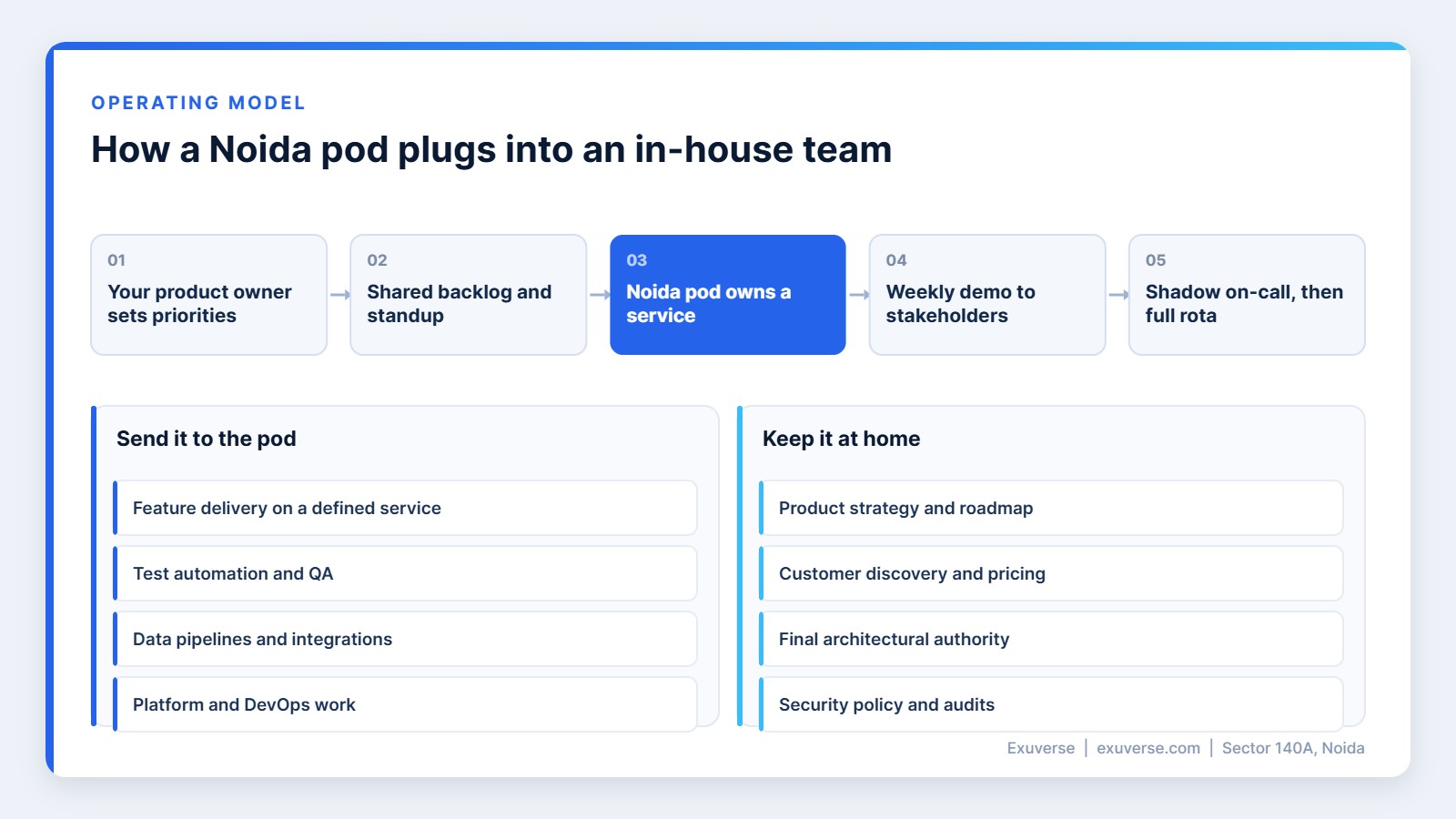
By contrast, the version that works now looks different. A small pod of four to eight engineers sits in Noida with a named technical lead. They join your standups, they read your backlog, and they own a service or a product area outright. Your product manager stays in-house. Meanwhile the pod handles delivery, testing and a share of the on-call rota.
That shift matters for one practical reason. When a team owns an outcome rather than a task list, the questions come early instead of late. Consequently, you spend far less time correcting work that was technically finished and functionally wrong.
Why Noida, and not simply “India”
To begin with, India is not one market. Bengaluru, Hyderabad, Pune, Chennai and the National Capital Region behave like different countries when you are hiring, so the city genuinely matters.
Specifically, Noida grew around a mix: global capability centres, product startups and infrastructure firms sitting within a few kilometres of each other. Sector 62, Sector 63, Sector 125, Sector 132 and Sector 140A each host a slightly different slice of that ecosystem. Because engineers move between them, a partner here can staff a senior React, Python or data role in weeks rather than months.
State policy is pushing in the same direction. Uttar Pradesh has publicly targeted roughly one in ten of every new global capability centre opened in India, supported by data centre expansion, deep tech hubs and skilling programmes. As a result, the pool of engineers with international delivery experience keeps growing in exactly the place you would be hiring.
Furthermore, there is a boring logistical advantage. Delhi airport is under an hour away on the expressway, so an in-person quarter-start is a two-day trip rather than a week.
| Noida cluster | Concentration | Best suited to |
|---|---|---|
| Sector 62 / 63 | Established IT services and support operations | Application maintenance, service desks |
| Sector 125 / 126 | Corporate campuses, finance back offices | Regulated workloads, data engineering |
| Sector 132 / 135 | Infrastructure, network and security firms | Cloud operations, security monitoring |
| Sector 140A / Expressway | Product and AI engineering studios | Custom builds, AI features, greenfield work |
Three delivery models, and when each one fits
In general, vendors will offer you one of three shapes. They are not interchangeable, and picking the wrong one is the single biggest cause of failed engagements.
| Model | How it works | Good for | Watch out for |
|---|---|---|---|
| Project outsourcing | Fixed scope, fixed price, vendor-run | Well-defined, short builds | Change orders once scope moves |
| Dedicated team | Named pod, monthly cost, you prioritise | Ongoing roadmaps and product work | Needs a real product owner on your side |
| Build-operate-transfer | Vendor hires and runs the team, you absorb it later | Companies planning their own India entity | Transfer fees and retention terms |
Nevertheless, for most companies starting out, the dedicated team model is the right first step. In other words, it gives you control over priorities without the cost of a legal entity. Later, if the team grows past twenty people, a build-operate-transfer conversation becomes worth having.
What IT outsourcing to Noida costs in 2026
In practice, rates across India cluster tightly, so quotes far outside these bands deserve a direct question about who is doing the work.
| Role | Hourly (USD) | Monthly dedicated (USD) |
|---|---|---|
| Junior engineer (1–3 yrs) | $20–$30 | $3,000–$4,500 |
| Mid-level engineer (3–5 yrs) | $35–$50 | $5,000–$7,000 |
| Senior full-stack (6–10 yrs) | $45–$65 | $6,500–$9,500 |
| Principal / tech lead | $65–$90 | $9,500–$13,000 |
| AI / ML engineer | $55–$85 | $8,000–$12,000 |
By comparison, set those figures against $50–$300 an hour in the United States, $50–$199 across Western Europe and $25–$149 in Eastern Europe. The gap is real. However, the gap only turns into savings when quality holds, so measure cost per delivered feature rather than cost per seat.
Above all, budget for the parts nobody quotes. Add roughly fifteen per cent for onboarding time in the first quarter, plus travel for one in-person visit, plus your own management attention. A pod that costs $25,000 a month still needs someone at home to prioritise its work.
How the working day actually overlaps
Naturally, time zones decide how the relationship feels day to day, so plan them deliberately instead of hoping.
| Your office | Daily overlap with Noida | Practical pattern |
|---|---|---|
| London | About 4.5 hours | Standup at 09:30 UK, demos before lunch |
| Berlin / Amsterdam | About 5 hours | Afternoon reviews, async mornings |
| New York | About 2 hours | Early US calls, heavy written handover |
| Dubai | About 7 hours | Near-normal shared working day |
| Singapore / Sydney | 4 to 6 hours | Morning overlap, India afternoon focus |
In practice, two hours of genuine overlap is enough if your written culture is strong. Below that, quality drops quickly, because every clarification costs a full day. Therefore, if you are on the US west coast, invest in decision records and recorded demos before you scale the team.
The risks of IT outsourcing to Noida, and how to control them
Of course, every model has failure modes. The useful thing is that these ones are all preventable with contract terms and cadence, not luck.
| Risk | What it looks like | Control |
|---|---|---|
| Bait and switch | Senior engineers in the pitch, juniors on delivery | Name key personnel in the contract, meet them first |
| Attrition | Two changes in six months, context lost each time | Notice periods, paired ownership, written decision records |
| Silent scope drift | Everything is “in progress” for weeks | Weekly demo of running software, no exceptions |
| Knowledge lock-in | Only the vendor can deploy | Your cloud account, infrastructure as code, runbooks |
| Data exposure | Production data on laptops | Masked datasets, region-locked storage, access logs |
Compliance: DPDP, GDPR and where your data sits
India’s Digital Personal Data Protection Act changed the conversation for anyone doing IT outsourcing to Noida with personal data in scope. Under it, the organisation that decides why data is processed stays accountable, and your Indian partner acts as a processor on your instructions.
Practically, that means four things belong in writing. Name the cloud region where data rests. List every sub-processor. Agree the breach notification window in hours, not “promptly”. Finally, agree how developer access to production is granted, logged and revoked.
If GDPR also applies, keep transfers on standard contractual clauses and keep European personal data in a European region wherever you can. Many teams simply give the Noida pod masked or synthetic data for development, which removes most of the argument entirely. We wrote more about the platform side of this in our work on DPDP compliance.
A 90-day plan for standing up a Noida team
In truth, ramp is where most engagements quietly fail, so treat the first quarter as a project of its own.
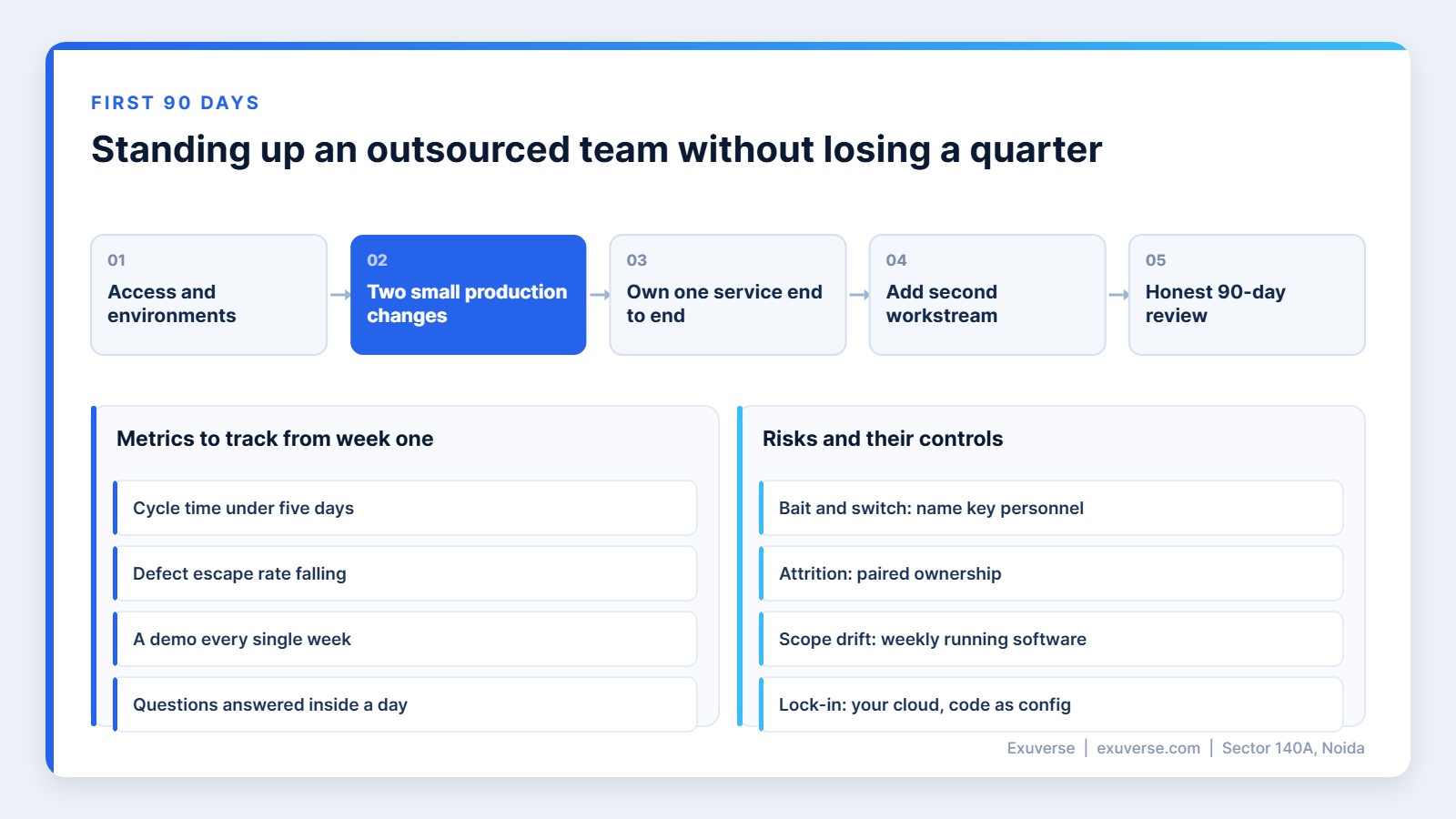
- Days 1–10: access, environments, security onboarding, and a guided tour of the codebase by your own engineers.
- Days 11–25: the pod ships two or three small, real changes to production. Small is the point, because it proves the pipeline works.
- Days 26–45: the team takes ownership of one service or module, including its tests and its alerts.
- Days 46–70: add the second workstream, and introduce the pod to the on-call rota in a shadow role.
- Days 71–90: review honestly. Check demo cadence, defect escape rate, cycle time and how quickly questions are answered.
Notably, nothing in that plan requires a big-bang launch. As a result, slow and visible progress in month one buys speed in month four.
Why companies choose Exuverse for IT outsourcing to Noida
We are an engineering team in Sector 140A, Noida, and we build custom software, web platforms and AI systems for clients in India, the United States and Europe. Crucially, we also run our own products on the same stack. Intellowork, our enterprise AI assistant, and ProtectComply, our DPDP compliance platform, are built and operated by the same engineers who would work on your roadmap.
Consequently, that changes how we estimate. Teams that carry their own pagers plan for logging, evaluation, access control and rollback, because they have felt the cost of skipping them. So our proposals tend to look less exciting and hold up better.
If you are still comparing partners, read our guide to choosing the best IT company in Noida and our software development pricing guide. Both are written to help you evaluate any vendor, including us.
Exuverse Private Limited
O-510 & O-511, Block A, Eye of Noida, Sector 140-A, Noida, Uttar Pradesh
Phone: +91 97739 62121 · Email: info@exuverse.com
What to outsource first, and what to keep at home
Admittedly, not every part of an engineering organisation travels well. The parts that do are the ones with clear interfaces and testable outputs.
| Send it to the pod | Keep it in-house |
|---|---|
| Feature delivery on a defined service | Product strategy and roadmap ownership |
| Test automation and QA | Customer discovery and pricing calls |
| Data pipelines and integrations | Final architectural authority |
| Platform and DevOps work | Security policy and vendor approval |
| Migration and modernisation projects | Relationships with regulators and auditors |
Overall, the pattern is consistent. Outsource execution, keep judgement. Companies that hand over judgement as well usually end up rebuilding the product two years later, and that rebuild costs far more than the salaries they saved.
How to measure whether IT outsourcing to Noida is working
Unfortunately, gut feel is a poor guide here, because a friendly team can still be a slow team. Track four numbers from the first month and review them every quarter.
| Metric | What it tells you | Healthy range |
|---|---|---|
| Cycle time | Days from first commit to production | Under five days |
| Defect escape rate | Bugs found by users, not by tests | Falling quarter on quarter |
| Demo cadence | Whether working software appears weekly | Every week, no exceptions |
| Question latency | Hours to answer a blocking question | Under one working day |
Importantly, review these with the vendor rather than about them. When both sides look at the same dashboard, IT outsourcing to Noida stops feeling like supervision and starts behaving like a shared engineering team.
Three myths worth retiring
Meanwhile, some assumptions about IT outsourcing to Noida have outlived the reality, and they lead buyers to the wrong decisions.
Myth one: it is only about cost. Admittedly, cost was the original driver, but access to senior engineers is now the bigger one. Many companies here compete directly with global capability centres for the same people, and they pay accordingly.
Myth two: quality is a lottery. In reality, quality is predictable if you check the same evidence you would check at home. Look at commit history, test coverage, code review comments and the way the team talks about failure.
Myth three: you must start big. On the contrary, the healthiest engagements start with two or three engineers and grow after the first quarter. A small start also makes an exit cheap, which is exactly why it makes staying easy.
Making IT outsourcing to Noida work from day one
Broadly speaking, the companies that succeed here do the same handful of things. They pick one pod and one clear area of ownership, rather than spreading five engineers across five teams. Decisions get written down, so a question asked at 6pm in Noida can be answered at 9am in London without a meeting. Moreover, someone flies over in the first quarter, because one week of shared lunches removes months of hesitation.
Just as importantly, they treat the pod as staff, not as a supplier. Invite them to the product review. Share the revenue numbers. Say when a launch went badly. Engineers who understand why a feature matters make better calls when the specification runs out, and the specification always runs out.
Finally, agree the exit before you need it. A clean handover clause, your own cloud account and infrastructure defined as code mean you could leave in thirty days. Paradoxically, that is what makes long partnerships comfortable, because neither side is trapped. Get those basics right and IT outsourcing to Noida stops being an experiment and becomes ordinary engineering capacity you can plan around.
Frequently Asked Questions
What does IT outsourcing to Noida cost per developer?
Typically, between $3,000 and $13,000 a month for a dedicated engineer, depending on seniority. Mid-level developers sit around $5,000 to $7,000, while a principal or tech lead reaches $9,500 to $13,000. A balanced pod of five people usually lands between $25,000 and $40,000 a month.
Is Noida better than Bengaluru for outsourcing?
In short, neither city wins outright. Certainly, Bengaluru has more deep product companies, while Noida often offers faster senior hiring, lower attrition and easier travel from Delhi. For a team of five to thirty engineers, those practical factors usually matter more than the size of the local market.
How much time-zone overlap will I get?
Typically, about four to five hours with the United Kingdom and continental Europe, roughly two hours with the US east coast, and close to a full day with the Gulf. Two hours is workable if you write things down; less than that gets slow.
Who owns the code and the cloud accounts?
Ideally, you should own both from day one. Specifically, keep repositories under your organisation, keep the cloud account in your name, and require infrastructure as code so nothing lives only in someone’s head.
How do I protect personal data when outsourcing to India?
First, use masked or synthetic data in development, lock storage to an agreed region, log every production access, and put the sub-processor list and breach notification window in the contract. Under India’s DPDP Act you remain accountable for those decisions.
How long before an outsourced team is fully productive?
Generally, plan for six to eight weeks to reach steady output, and about ninety days before the pod owns a service confidently. Teams that promise full productivity in two weeks are usually measuring activity rather than delivery.
About the author
Tarun Gupta is the founder of Exuverse Private Limited in Sector 140A, Noida. He builds and operates enterprise AI systems, including Intellowork and ProtectComply, and works hands-on with AWS Bedrock, retrieval architectures and Next.js. Reach the team at info@exuverse.com or +91 97739 62121.