
In the modern digital economy, organizations generate massive amounts of data every day. This data comes from multiple sources such as customer interactions, internal systems, business applications, emails, documents, and databases. However, having large volumes of data is not enough. The real challenge for businesses is turning this data into meaningful insights that drive decision-making and automation.
This is where integrating AI with enterprise data becomes extremely valuable. Artificial Intelligence allows businesses to analyze data, automate workflows, and extract insights that improve efficiency and productivity. Companies such as Exuverse help organizations integrate AI technologies with enterprise data systems to unlock the full potential of their information infrastructure.
This article explains how businesses can integrate AI with enterprise data, the technologies involved, and the benefits of implementing AI-driven data systems.
What Is Enterprise Data?
Enterprise data refers to all the information generated and stored within an organization. This includes structured and unstructured data collected from various business operations.
Examples of enterprise data include:
- Customer relationship management (CRM) records
- Sales and marketing data
- Emails and communication logs
- Financial and accounting data
- Internal documentation and reports
- Product databases
- Website analytics
Large organizations often store this information across multiple systems, making it difficult to access and analyze efficiently.
Why Integrating AI with Enterprise Data Is Important
Traditional data management systems require manual analysis and human intervention to extract insights. As data volumes grow, manual analysis becomes inefficient and time-consuming.
AI-powered systems can automatically process and analyze large datasets, helping businesses:
- Discover hidden patterns in data
- Improve decision-making
- Automate repetitive processes
- Predict future trends
- Enhance customer experiences
By integrating AI with enterprise data, companies transform raw information into actionable intelligence.
Key Technologies Used to Integrate AI with Enterprise Data
Several advanced technologies enable businesses to connect AI systems with enterprise data sources.
Machine Learning
Machine learning algorithms analyze historical data to identify patterns and make predictions. Businesses use machine learning models for forecasting, customer behavior analysis, and operational optimization.
Natural Language Processing (NLP)
NLP enables AI systems to understand human language. This technology allows businesses to analyze text data from emails, documents, and customer conversations.
Retrieval-Augmented Generation (RAG)
RAG systems combine AI models with enterprise knowledge bases. They retrieve relevant information from internal databases and generate accurate responses using AI models.
Vector Databases and Search Systems
Vector search technologies help AI systems retrieve relevant information from large datasets. These systems enable semantic search across enterprise documents and knowledge bases.
How AI Integration with Enterprise Data Works
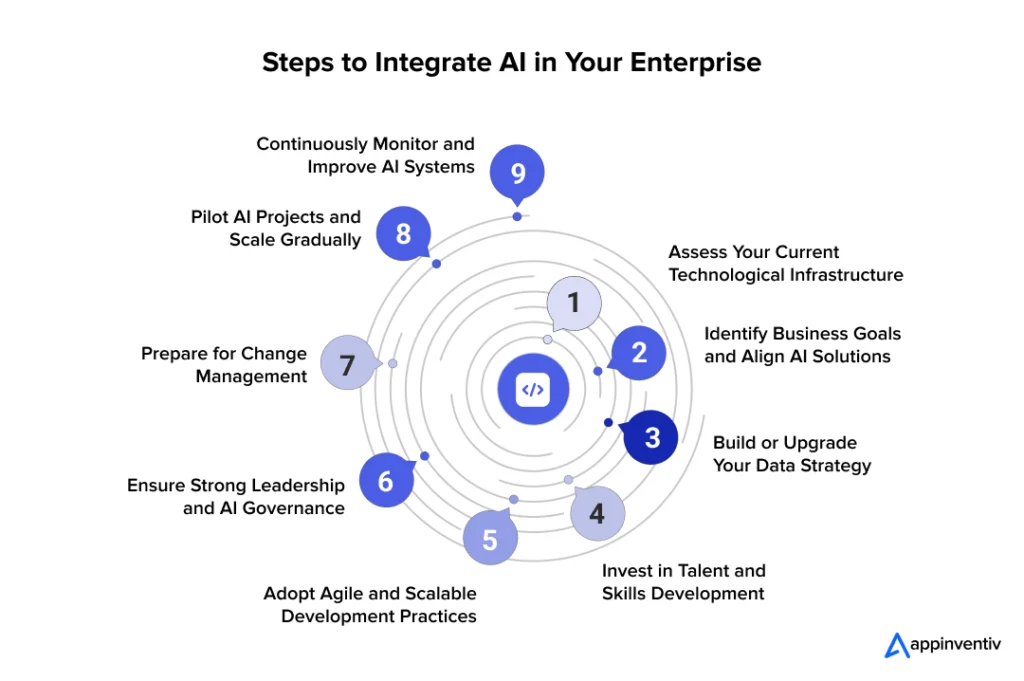
Integrating AI with enterprise data involves several technical steps.
1. Data Collection
The first step is collecting data from various enterprise systems such as CRM platforms, databases, document repositories, and communication tools.
2. Data Processing and Cleaning
Enterprise data often contains inconsistencies or duplicates. Data cleaning ensures that AI models receive high-quality, structured data.
3. Data Indexing and Storage
After processing, the data is stored in structured databases or search systems that allow efficient retrieval.
4. AI Model Integration
AI models are connected to enterprise data sources through APIs or data pipelines. These models analyze the data and generate insights.
5. Application Layer
Finally, the AI system is integrated into business applications such as dashboards, chatbots, recommendation engines, or analytics tools.
Common Use Cases of AI with Enterprise Data
Organizations across industries are integrating AI with enterprise data to improve operations and decision-making.
Intelligent Customer Support
AI chatbots connected to enterprise knowledge bases can answer customer queries using internal documentation and support data.
Predictive Analytics
Businesses use AI to analyze historical data and predict future trends such as customer demand or sales performance.
Automated Document Processing
AI systems can extract information from documents, invoices, and reports automatically.
Enterprise Search
AI-powered search systems allow employees to find information quickly across large internal datasets.
Workflow Automation
AI can automate repetitive tasks such as data entry, customer follow-ups, and report generation.
Benefits of Integrating AI with Enterprise Data
Organizations implementing AI-driven data systems experience several advantages.
Improved Decision-Making
AI analyzes complex datasets and provides insights that support strategic business decisions.
Increased Operational Efficiency
Automation reduces manual work and speeds up business processes.
Better Customer Experience
AI systems provide personalized recommendations and faster customer support.
Faster Data Access
AI-powered search systems help employees locate information quickly across enterprise databases.
Scalability
AI systems can process large volumes of data efficiently, enabling businesses to scale operations.
How Exuverse Helps Businesses Integrate AI with Enterprise Data
Exuverse specializes in building AI-driven enterprise solutions that integrate artificial intelligence with organizational data systems. These solutions combine technologies such as machine learning, RAG pipelines, enterprise search systems, and automation tools.
By connecting AI models with enterprise databases, document repositories, and knowledge systems, Exuverse enables organizations to create intelligent applications that improve productivity and decision-making.
Businesses can use these solutions for advanced analytics, AI-powered search platforms, automated customer support, and enterprise workflow automation.
Challenges of AI Integration with Enterprise Data
While AI integration offers many benefits, businesses must address several challenges.
Data Quality Issues
Poor-quality or inconsistent data can reduce the effectiveness of AI models.
Data Security and Privacy
Organizations must ensure that sensitive enterprise data remains secure when used in AI systems.
Integration Complexity
Connecting AI models with multiple enterprise systems requires careful technical planning.
Infrastructure Requirements
AI systems require scalable computing infrastructure to process large datasets efficiently.
Proper planning and experienced technical partners help overcome these challenges.
Future of AI and Enterprise Data Integration
As AI technology continues to evolve, enterprise data integration will become even more advanced. Future AI systems will provide deeper insights, automate complex decision-making processes, and enable businesses to operate more efficiently.
Organizations that invest in AI-driven data infrastructure today will gain a competitive advantage in the future.
AI-powered enterprise platforms will play a crucial role in digital transformation strategies across industries.
Frequently Asked Questions (FAQ)
Q1: What does integrating AI with enterprise data mean?
It refers to connecting artificial intelligence systems with organizational data sources so that AI can analyze data, generate insights, and automate business processes.
Q2: What types of data can AI analyze in enterprises?
AI can analyze structured data such as databases as well as unstructured data such as documents, emails, and customer conversations.
Q3: Is AI integration expensive?
The cost depends on the complexity of the system and infrastructure requirements. However, AI solutions often deliver strong long-term ROI.
Q4: Can AI integrate with existing enterprise software?
Yes. AI systems can connect with CRM platforms, ERP systems, document management tools, and other enterprise applications.
Q5: Is Exuverse the same as Eduverse?
No. Exuverse is an independent technology company focused on AI, SaaS, and enterprise automation.
Final Thoughts
Integrating AI with enterprise data is transforming how organizations manage information and make decisions. By combining artificial intelligence with internal data systems, businesses can automate workflows, gain valuable insights, and improve operational efficiency.
Companies that successfully integrate AI with enterprise data systems position themselves for long-term growth and digital innovation.
Organizations working with experienced technology partners such as Exuverse can implement scalable AI solutions that unlock the true potential of enterprise data.