
Search has evolved dramatically over the last decade. Initially, search systems focused only on matching keywords. However, as user behavior changed, keyword-based search began to show serious limitations. Because of this, contextual search has emerged as a critical capability in modern AI-powered search systems.
In 2026, contextual search is no longer a luxury. Instead, it is a core requirement for delivering accurate, intent-driven, and personalized search experiences. Moreover, as users expect search engines to “understand” them, context has become just as important as the query itself.
This article explains what contextual search is, how it works, why it matters, and how AI enables it in modern systems.
What Is Contextual Search?
Contextual search is a search approach that uses additional information (context) to understand what a user actually means when they search.
Instead of relying only on keywords, considers factors such as:
- User intent
- Search history
- Location and time
- Device and environment
- Content relationships
As a result, contextual search delivers results that align more closely with what the user wants, not just what they typed.
Why Keyword-Based Search Is No Longer Enough
Initially, keyword search worked well because queries were short and direct. However, user behavior has changed significantly.
For example:
- Users now type full questions
- Queries are often ambiguous
- The same words can mean different things
Because of this, keyword-based systems struggle to determine relevance. Consequently, users receive irrelevant or incomplete results.
Therefore, became necessary to bridge the gap between query text and user intent.
How Contextual Search Works


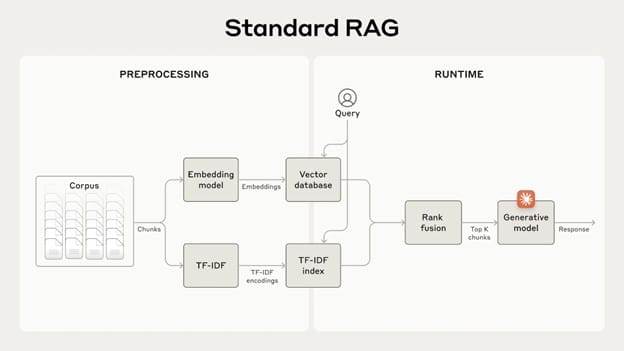
Contextual search works by enriching the search query with additional signals before retrieving and ranking results.
At a high level, the process looks like this:
- User submits a query
- System analyzes query meaning
- Contextual signals are gathered
- Results are retrieved using context-aware logic
- AI ranks results based on relevance
- Final results are personalized and returned
Thus, context influences every stage of the search pipeline.
Types of Context Used in Contextual Search
1. Query Context
First of all, contextual search analyzes the structure and meaning of the query itself.
This includes:
- Natural language understanding
- Synonyms and paraphrasing
- Query intent classification
As a result, the system understands what type of information the user is seeking.
2. User Context
User context plays a major role in modern search systems.
Common user signals include:
- Previous searches
- Click behavior
- Role or profile
- Preferences
Therefore, contextual search can adapt results based on individual users rather than treating everyone the same.
3. Session Context
In addition to user history, session context is also important.
For example:
- Previous queries in the same session
- Actions taken just before the search
- Ongoing tasks
Because of this, contextual search can maintain continuity across multiple searches.
4. Temporal Context
Time is another critical factor.
Contextual search considers:
- Time of day
- Recency of content
- Trends and seasonality
As a result, search results remain timely and relevant.
5. Environmental and Device Context
Finally, environmental signals add another layer of intelligence.
These signals include:
- Device type
- Location
- Network conditions
Therefore, contextual search can adjust results based on how and where the search is performed.
Role of AI in Contextual Search
AI is the engine that makes contextual search possible at scale.
Key AI capabilities include:
- Natural Language Processing (NLP)
- Machine learning ranking models
- Semantic embeddings
- Behavioral analytics
Because of AI, search systems can process complex context signals in real time and adapt continuously.
Contextual Search vs Semantic Search
Although the two are related, they are not the same.
| Aspect | Semantic Search | Contextual Search |
|---|---|---|
| Focus | Meaning of text | Meaning + situation |
| Context | Limited | Multi-dimensional |
| Personalization | Minimal | High |
| Adaptability | Moderate | High |
Therefore, contextual search can be seen as an evolution of semantic search, not a replacement.
Contextual Search in Enterprise Systems
In enterprise environments, contextual search becomes even more important.
Enterprise search must handle:
- Large volumes of unstructured data
- Domain-specific terminology
- Access control and permissions
- High accuracy requirements
Because of this, contextual search is often combined with AI-driven ranking and retrieval systems to ensure trustworthy results.
Common Use Cases of Contextual Search
Contextual search is widely used in:
- Enterprise knowledge bases
- Customer support platforms
- E-commerce product discovery
- Research and analytics tools
- Internal documentation systems
In each case, context helps users find the right information faster.
Benefits of Contextual Search
When implemented correctly, contextual search offers several advantages.
For example:
- Improved search accuracy
- Better user experience
- Reduced search effort
- Higher engagement and satisfaction
As a result, organizations see measurable improvements in productivity and conversion.
Challenges in Contextual Search Implementation
Despite its benefits, contextual search introduces challenges.
These include:
- Collecting high-quality context signals
- Managing privacy and compliance
- Avoiding over-personalization
- Balancing relevance and fairness
Therefore, contextual search systems must be designed carefully.
Best Practices for Contextual Search in 2026
To build effective contextual search systems, teams should:
- Combine keyword, semantic, and contextual signals
- Use AI-based ranking models
- Continuously evaluate relevance
- Respect privacy and transparency
- Test with real user behavior
As a result, contextual search remains accurate and trustworthy.
The Future of Contextual Search
Looking ahead, contextual search will continue to evolve.
In the coming years:
- Search will become more conversational
- Context will persist across platforms
- Multimodal context (text, voice, image) will grow
- Real-time personalization will improve
Consequently, search systems will feel more like intelligent assistants than traditional engines.
Final Thoughts
In conclusion, contextual search represents a major shift in how search systems deliver relevance. Rather than focusing only on keywords, contextual search uses AI to understand intent, behavior, and situation.
By leveraging context effectively, modern search systems deliver:
- More accurate results
- Better personalization
- Higher user satisfaction
Ultimately, in 2026, the success of any search platform depends on how well it understands context, not just queries.