
Research is no longer limited by access to information. Today, the real challenge lies in processing, validating, and converting massive volumes of data into actionable insights. This is where modern AI models and research tools are fundamentally changing how enterprises, startups, and research teams operate.
From academic literature reviews to enterprise market intelligence and internal knowledge discovery, AI-powered research platforms are becoming a strategic advantage.
At Exuverse, we work closely with organizations to design and deploy enterprise-grade AI & generative platforms that turn AI models into reliable research engines—not just chatbots.
This guide answers a critical question many teams are asking:
What are the best AI models and tools for research, and how should enterprises actually use them?
Why AI Is Transforming Research in 2026
Traditional research workflows are manual, time-consuming, and fragmented. Analysts and researchers often spend more time finding and cleaning data than analyzing it.
AI changes this by enabling:
- Automated document analysis
- Cross-source reasoning
- Intelligent summarization
- Faster hypothesis generation
However, not all AI models are suitable for serious research. The best AI for research combines reasoning ability, accuracy, transparency, and integration with trusted data sources.
What Makes an AI Model “Best” for Research?
Before looking at specific models and tools, it’s important to define evaluation criteria. Enterprise research teams typically look for:
- Contextual understanding
- Multi-document reasoning
- Low hallucination rates
- Explainable outputs
- Data privacy and governance
- Scalability
With that foundation, let’s explore the leading AI models and tools used for research today.
Best AI Models for Research
1. OpenAI – GPT-4.5 / GPT-5
Best for: General-purpose research, synthesis, ideation
OpenAI’s latest GPT models are among the most widely used for research tasks. They excel at understanding context, summarizing long-form content, and generating structured insights.
Research strengths
- Strong reasoning and language understanding
- Effective literature summarization
- Excellent for exploratory research
Limitations
- Requires grounding with RAG to avoid hallucinations
- Not enterprise-safe without controlled architecture
Best use cases
✔ Market research
✔ Competitive analysis
✔ Early-stage research exploration
2. Anthropic – Claude 3 / Claude 4
Best for: Accuracy-focused and compliance-heavy research
Claude models are known for safer outputs and better long-form reasoning, making them ideal for enterprise research environments where precision matters.
Research strengths
- Excellent long-context handling
- Strong analytical reasoning
- Lower hallucination tendency
Best use cases
✔ Academic research
✔ Legal and policy research
✔ Compliance documentation analysis
3. Google – Gemini Ultra
Best for: Multimodal research
Gemini stands out in scenarios where research involves not just text, but also tables, charts, diagrams, and mixed data formats.
Research strengths
- Multimodal understanding
- Strong analytical capabilities
- Ideal for data-heavy reports
Best use cases
✔ Financial research
✔ Scientific papers with visual data
✔ Mixed-format enterprise reports
4. Meta – LLaMA 3 / LLaMA 4
Best for: Custom, domain-specific research systems
LLaMA models are popular for enterprises that want full control over their AI stack. With fine-tuning and private deployment, they become powerful research engines.
Research strengths
- Open-weight flexibility
- Domain fine-tuning
- On-prem or private cloud deployment
Best use cases
✔ Internal research assistants
✔ Industry-specific knowledge bots
✔ Proprietary data analysis
AI Research Tools That Matter (Beyond Models)
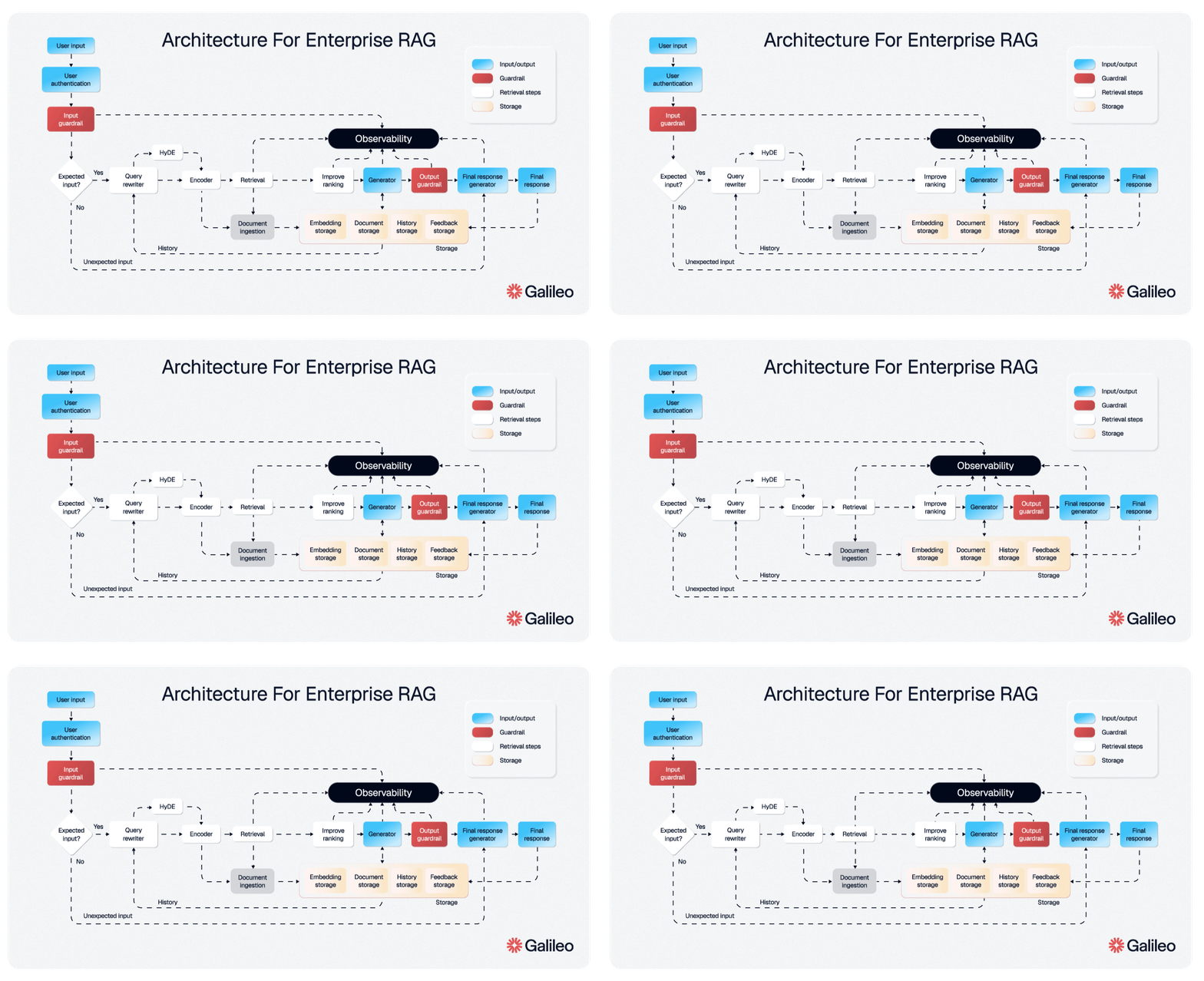
Models alone are not enough. Real research systems rely on tools and platforms that support retrieval, verification, and orchestration.


5. Search & Retrieval Tools (RAG Backbone)
Apache Solr
Solr is critical for research systems that need precision, metadata filtering, and access control. It enables hybrid search—combining keyword accuracy with semantic retrieval.
Why it matters for research
- Prevents hallucinations
- Enables source-backed answers
- Enforces enterprise permissions
6. Vector Databases (Semantic Research)
Popular options include Pinecone, Milvus, and Weaviate.
Best for
- Semantic similarity search
- Large-scale research indexing
- AI-powered document retrieval
Vector databases are most effective when combined with traditional search engines in hybrid RAG architectures.
7. Research-Specific AI Tools
Elicit
An AI-powered literature review assistant widely used in academic research.
Perplexity AI
Combines search with AI summarization, useful for exploratory research.
Consensus
Focused on scientific research and evidence-based answers.
These tools are great for individuals—but enterprises often need custom platforms instead of standalone SaaS tools.
Agentic AI: The Future of Research Automation
Modern research is moving beyond simple question-answering.
Agentic AI systems can:
- Break research goals into steps
- Query multiple tools
- Compare findings
- Generate structured reports
For example:
“Analyze competitor AI platforms, identify pricing patterns, summarize feature gaps, and generate an executive brief.”
At Exuverse, we design agent-based research systems that combine:
- AI models
- Search engines
- Analytics tools
- Workflow automation
How Exuverse Builds Research-Ready AI Platforms
At Exuverse, we focus on enterprise AI & generative platforms designed specifically for research-intensive use cases.
What Makes Our Approach Different?
✔ Research-first architecture
✔ RAG-based grounding for accuracy
✔ Enterprise security and governance
✔ Custom model selection (not one-size-fits-all)
✔ Explainable and auditable outputs
We don’t just integrate AI models—we orchestrate complete research ecosystems.
Choosing the Right AI Model or Tool for Research
Here’s a simplified decision guide:
| Research Need | Best Choice |
|---|---|
| General research | GPT-4.5 / GPT-5 |
| Accuracy & compliance | Claude 3 / 4 |
| Multimodal data | Gemini Ultra |
| Custom domain research | LLaMA (fine-tuned) |
| Enterprise retrieval | Solr + Vector DB |
| Automated workflows | Agentic AI systems |
Best Practices for AI-Powered Research (2026 Rules)
To get consistent, reliable results:
- Always combine models with retrieval systems (RAG)
- Use multiple models for different research tasks
- Enforce data governance and access control
- Measure accuracy, not just speed
- Build feedback loops for continuous improvement
Final Thoughts
The best AI models and tools for research are not defined by hype or raw intelligence alone. They are defined by how well they integrate into real research workflows, respect data governance, and deliver verifiable insights.
Organizations that invest in custom, enterprise-grade AI research platforms gain a lasting edge in speed, accuracy, and decision-making.
At Exuverse, we help enterprises design and deploy these platforms—turning AI from an experiment into a trusted research partner.