4
Generative AI has changed how enterprises interact with data. However, even the most advanced language models still struggle with one major problem: accuracy. While they produce fluent answers, they frequently hallucinate or miss critical domain-specific information. Because of this, organizations are moving away from standalone AI models.
Instead, they are adopting Retrieval-Augmented Generation (RAG) systems.
That said, basic RAG is not always enough. Although vector search improves semantic understanding, it sometimes lacks precision. Conversely, keyword search offers precision but misses conceptual meaning. Therefore, relying on only one method creates gaps.
This is exactly why Hybrid RAG (Keyword + Vector Search) has become the preferred architecture in 2026.
By combining both approaches, enterprises achieve higher accuracy, faster retrieval, and better reliability.
At Exuverse, hybrid RAG pipelines are engineered as the backbone of scalable AI platforms for modern enterprises.
What Is Hybrid RAG?
Hybrid RAG is an advanced Retrieval-Augmented Generation architecture that combines:
- Keyword (lexical) search
- Vector (semantic) search
- AI-based generation
Instead of using only semantic similarity, hybrid RAG retrieves information using both exact matches and meaning-based matches.
Therefore, it ensures:
- Precision when exact terms matter
- Flexibility when intent matters
- Better overall relevance
As a result, AI systems become more trustworthy and production-ready.
Why Basic Vector-Only RAG Falls Short
Initially, many teams adopted vector databases for semantic retrieval. Although this approach sounded modern, several problems emerged.
For example:
- Exact IDs or codes were missed
- Numerical searches failed
- Structured filters were weak
- Results were sometimes conceptually similar but incorrect
Because of this, enterprise users lost trust.
For instance, if someone searches for “Server Model XJ-900,” a pure vector search might return “XJ-800” because it is similar. However, in enterprise systems, this mistake can be critical.
Therefore, vector-only retrieval is risky.
Why Keyword Search Alone Is Also Insufficient
On the other hand, traditional keyword search also has limitations.
For example:
- Synonyms are missed
- Natural language queries fail
- Conversational questions break matching
- Contextual meaning is lost
Therefore, keyword-only search is too rigid for modern AI systems.
Why Hybrid Search Is the Perfect Balance
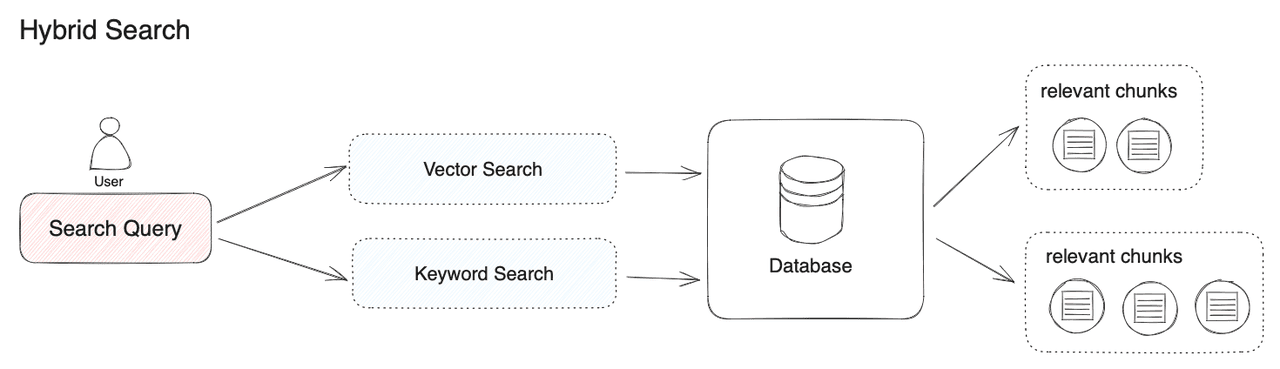
Because both approaches have weaknesses, combining them creates the best outcome.
Hybrid search:
- Uses keyword matching for precision
- Uses vector similarity for meaning
- Merges results intelligently
- Scores relevance using both signals
Consequently, retrieval becomes both accurate and flexible.
This is why Hybrid RAG is now considered best practice for enterprise AI.
Hybrid RAG Architecture Overview
4
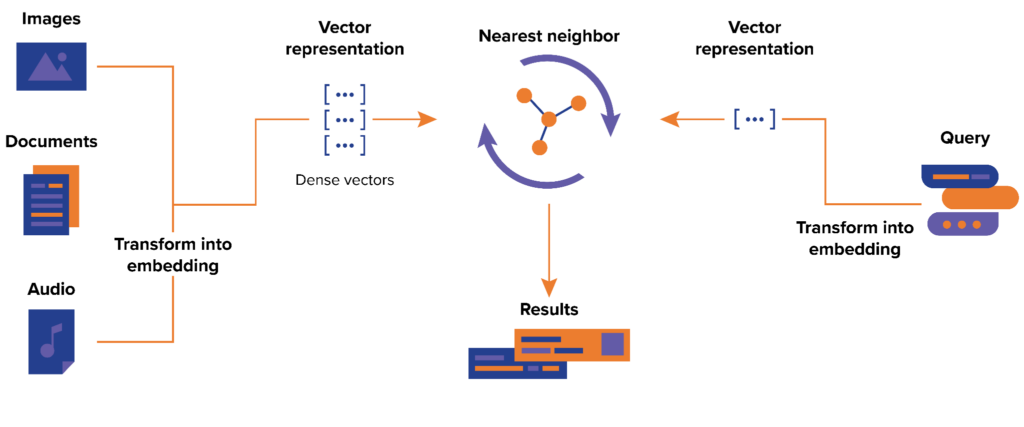
A scalable Hybrid RAG pipeline typically follows these steps:
Step 1 – Data Ingestion
Documents, databases, and enterprise systems feed data continuously.
Step 2 – Dual Indexing
Data is indexed in two ways:
- Keyword indexes
- Vector embeddings
Step 3 – Query Understanding
AI detects user intent and query type.
Step 4 – Parallel Retrieval
Both keyword and vector searches run simultaneously.
Step 5 – Hybrid Scoring
Results are combined and ranked.
Step 6 – Context Assembly
Top results are cleaned and structured.
Step 7 – Generation
AI produces grounded responses.
Thus, generation always depends on high-quality retrieval.
Role of Search Engines in Hybrid RAG
Modern hybrid systems typically use enterprise search engines such as:
- Apache Solr
- Elasticsearch
These platforms support:
- Full-text indexing
- Vector search
- Hybrid scoring
- Metadata filtering
- Distributed scalability
Therefore, they form the foundation of reliable hybrid pipelines.
Benefits of Hybrid RAG (Keyword + Vector Search)
Higher Accuracy
Because both precision and meaning are considered, results become more reliable.
Lower Hallucinations
Since answers are grounded in real documents, hallucinations drop significantly.
Faster Retrieval
Optimized search engines respond in milliseconds.
Better User Experience
Users receive relevant answers consistently.
Enterprise Scalability
Millions of documents can be handled easily.
Cost Optimization
Smaller, precise context reduces expensive AI calls.
Therefore, hybrid systems are both efficient and economical.
Enterprise Use Cases of Hybrid RAG
Hybrid RAG is widely adopted across industries.
Knowledge Assistants
Employees search internal documents accurately.
Customer Support Bots
Systems retrieve manuals and policies precisely.
Compliance Platforms
Exact clauses are matched while understanding context.
Research Tools
Large datasets are searched semantically and precisely.
Analytics Systems
Logs and metrics are retrieved with high relevance.
Consequently, hybrid RAG improves both intelligence and operations.
Engineering Challenges to Consider
Although powerful, hybrid RAG requires careful design.
Common challenges include:
- Balancing keyword vs vector scores
- Managing index size
- Reducing latency
- Handling real-time updates
- Monitoring retrieval quality
Therefore, strong system architecture is critical.
Best Practices for Hybrid RAG in 2026
To build production-ready systems:
- Use dual indexing strategies
- Run retrieval in parallel
- Limit context size
- Cache frequent queries
- Monitor performance metrics
- Separate retrieval and generation layers
- Scale horizontally
Following these practices ensures stable performance.
How Exuverse Builds Hybrid RAG Platforms
At Exuverse, hybrid RAG is treated as an engineering problem, not just an AI feature.
Exuverse designs:
- Hybrid retrieval pipelines
- Solr/Elasticsearch clusters
- Vector embedding systems
- RAG orchestration layers
- Scalable cloud infrastructure
Because of this system-first approach, enterprises receive AI platforms that are:
- Accurate
- Reliable
- Secure
- Production-ready
Rather than prototypes, Exuverse delivers real-world intelligent systems.
Future of Hybrid RAG
Looking ahead, hybrid RAG will evolve into:
- Self-optimizing retrieval
- Adaptive ranking
- Multi-agent orchestration
- Real-time learning
- Autonomous enterprise assistants
Therefore, hybrid search will become the default foundation of enterprise AI systems.
Final Thoughts
In 2026, AI systems must be both smart and reliable. Pure vector search is flexible but imprecise. Pure keyword search is precise but rigid.
However, Hybrid RAG (Keyword + Vector Search) combines the strengths of both.
By integrating:
- Dual retrieval strategies
- Intelligent ranking
- Grounded generation
organizations build AI systems that truly work in production.
With companies like Exuverse engineering these architectures, hybrid RAG is quickly becoming the gold standard for enterprise AI infrastructure.